

Standard Operating Procedures (SOPs) are the key to growing your expert business without burning out. They document your workflows, making it easier to delegate tasks, maintain quality, and reduce inefficiencies. By turning repetitive processes into clear, step-by-step guides, SOPs free up your time and help your team operate independently.
Key Takeaways:
- What are SOPs? Step-by-step instructions for tasks like client onboarding, invoicing, and lead generation.
- Why do they matter? They reduce errors, save time, and ensure consistency across your business.
- How do they help growth? By enabling delegation, improving training, and increasing operational efficiency.
SOPs aren’t just for big corporations – they’re essential for scaling any business where expertise drives success. Start small by documenting one recurring task, and watch how it transforms your operations.
How Smart CEOs Scale FAST in 2025 (SOPs Explained)
Key Benefits of SOPs for Expert Businesses
SOPs (Standard Operating Procedures) offer three key advantages that can directly influence your business’s efficiency, service quality, and growth potential.
Maintaining Consistency and Quality in Service Delivery
SOPs act as a roadmap, ensuring that every client experiences the same level of excellence, no matter who on your team delivers the service. By documenting processes, you eliminate guesswork and avoid relying on memory.
Take McDonald’s, for example. Their SOPs ensure that a Big Mac tastes the same whether you’re in Tokyo or Cleveland. Similarly, Hilton Hotels & Resorts uses detailed SOPs across all departments – housekeeping, customer service, and beyond – to maintain a consistent guest experience worldwide. Even in high-stakes environments like Johns Hopkins Hospital, SOPs have been game-changing. Their surgical procedure checklists for pre- and post-operative care have significantly reduced complications and errors.
A crucial part of an effective SOP is a "Definition of Done." This ensures that tasks meet clear, measurable standards before they’re marked as complete. For instance, high-stakes deliverables might require mandatory peer reviews or manager approvals. As Fluidwave aptly states:
An SOP without defined roles is merely a suggestion. Accountability is what transforms a document into a reliable business process.
Improving Efficiency and Productivity
SOPs aren’t just about consistency – they’re also a major time-saver. Workers lose an average of 100 minutes a day – over 20% of their work hours – searching for the information they need to do their jobs. SOPs eliminate this inefficiency by providing clear, step-by-step instructions.
By reducing dependency on specific individuals, SOPs free up senior staff to focus on strategic tasks instead of answering repetitive questions. Anna Taylor from Prialto describes it well:
SOPs are like invisible infrastructure. They keep your business humming behind the scenes.
Simplifying Team Training and Onboarding
SOPs also streamline onboarding, turning what can be a time-consuming process into a largely self-guided one. Instead of spending hours training new hires, you can direct them to detailed, documented procedures that break down tasks into easy-to-follow steps.
This approach minimizes disruptions to senior staff and allows new team members to learn at their own pace. Adding video walkthroughs can make a big difference, improving retention by 54%. As Elizabeth Yarbrough puts it:
The best way to manage people is to equip them to manage themselves.
How SOPs Enable Scalability and Growth
Creating Repeatable Processes
SOPs break down complex workflows into clear, repeatable steps, making it easier for businesses to scale without hitting operational bottlenecks. This kind of standardization is what separates businesses that grow smoothly from those that get stuck when the founder or key personnel become overwhelmed.
Take Toyota, for instance. Through the Toyota Production System, they leveraged SOPs to achieve incredible cost savings and quality control, enabling their global expansion. By documenting essential processes, businesses can eliminate single points of failure. This not only streamlines operations but also empowers teams to work more effectively.
SOPs also improve profit margins by speeding up turnaround times. And if you’re looking to sell your business, having documented processes can significantly increase its value. Thomas Smale, Founder of FE International, puts it well:
"Having SOPs in place can have a positive impact on [transferability, scalability, and sustainability]… reducing dependence on the owner or any individual employee has a beneficial effect on sustainability."
Improving Team Autonomy and Morale
Far from being restrictive, SOPs provide a framework that fosters autonomy. This is especially important for scaling businesses, as it allows employees to make decisions and complete tasks without constant oversight. With clear, step-by-step instructions, team members can work confidently, reducing both stress and mistakes.
By handling routine tasks through SOPs, employees can dedicate more time to strategic and creative projects – the kind of work they find most fulfilling. This balance boosts both efficiency and job satisfaction. A striking example of SOPs in action occurred in January 2009, when US Airways Flight 1549 faced an emergency. After a bird strike caused total engine failure, Captain Chesley "Sully" Sullenberger and his crew relied on emergency SOP checklists to guide their response. Their adherence to these procedures saved all 155 lives on board.
In a business context, adopting a process-driven approach can yield similar benefits. For instance, Dax Kimbrough of Sweat+Co introduced time-tracking and standardized workflows to identify inefficiencies. This shift increased the firm’s profitability by at least 20%.
To illustrate the difference SOPs make, here’s a comparison between SOP-driven processes and ad-hoc approaches:
Comparison Table: SOPs vs. Ad-Hoc Processes
| Metric | SOP-Driven Processes | Ad-Hoc Processes |
|---|---|---|
| Consistency | High: outcomes are predictable | Low: results vary depending on the individual |
| Training Time | Fast: new hires rely on self-serve documentation | Slow: requires extensive one-on-one shadowing |
| Error Reduction | High: checklists prevent mistakes and missed steps | Low: memory and guesswork lead to errors |
| Scalability | High: processes can scale across teams | Limited: growth is tied to the founder’s availability |
| Team Autonomy | High: clear guidelines empower independence | Low: frequent managerial input is necessary |
| Knowledge Retention | Institutional: knowledge stays with the company | Tribal: knowledge leaves with the employee |
sbb-itb-f54b9a0
How to Implement SOPs: A Practical Guide
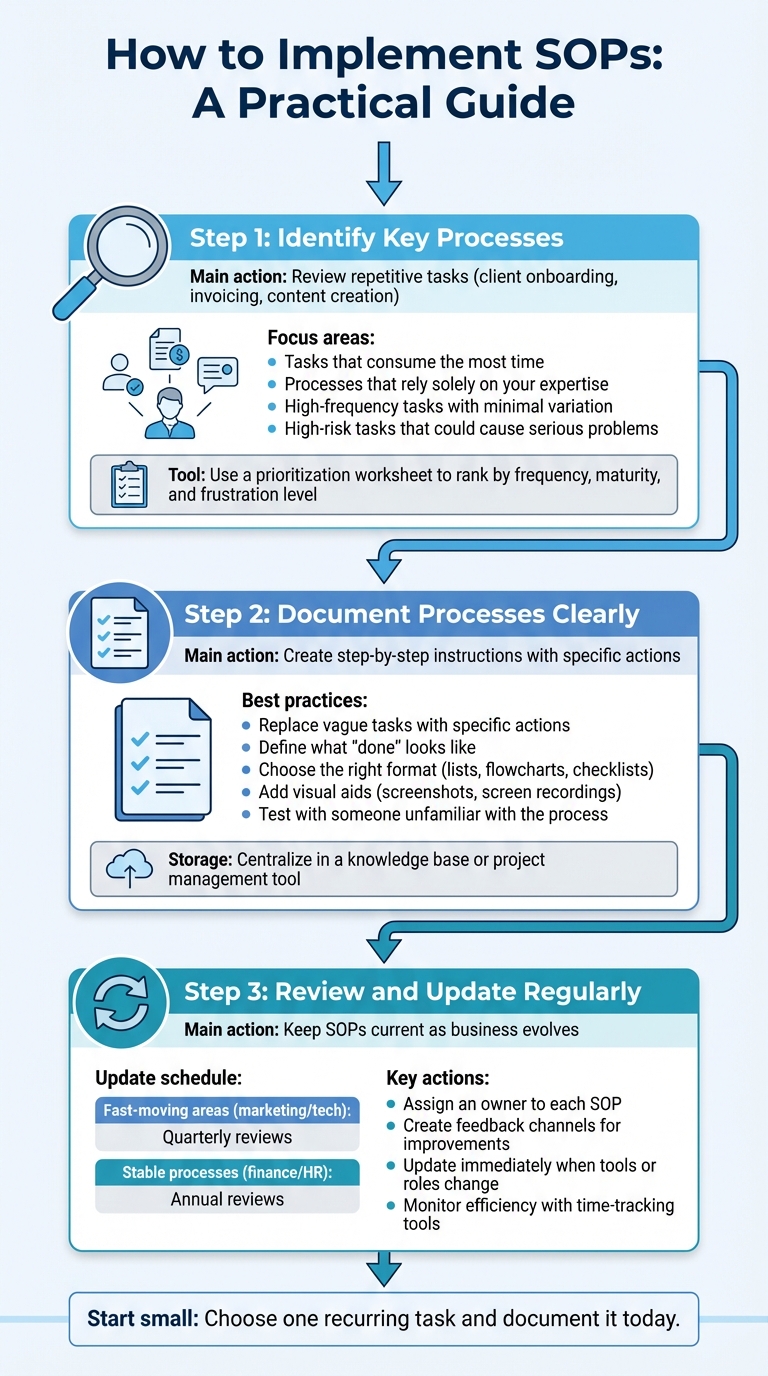
3-Step Process for Implementing SOPs in Expert Businesses
Step 1: Identify Key Processes
Start by reviewing all repetitive tasks you handle regularly, like client onboarding, invoicing, or content creation. The goal? Spot patterns and pinpoint the processes that consume the most time or cause the most confusion. This step ensures you focus on what matters most to your business.
Pay special attention to tasks that rely solely on your expertise. If certain processes can’t be delegated because they live in your head, they’re keeping you tied to daily operations instead of focusing on growth. For businesses that charge flat fees, standardizing billable work is a game-changer – it boosts efficiency, increases your hourly rate, and improves profit margins.
Focus on processes that repeat often, have minimal variation, and directly impact customer satisfaction or revenue. Also, identify areas where mistakes could lead to serious problems, like lost deals, legal trouble, or strained client relationships. These high-risk tasks should be documented immediately. To prioritize effectively, use a simple worksheet to rank processes based on frequency, current maturity, and the level of frustration or errors they cause.
Once you’ve identified the key processes, it’s time to document them in detail.
Step 2: Document Processes Clearly
Clarity is everything when documenting processes. Provide step-by-step instructions, replacing vague tasks with specific actions. For example, instead of saying, "Send the welcome email", write: "Open the CRM, click ‘New Client Workflow,’ choose the welcome email template, and personalize it with the client’s name". Define what "done" looks like for each task to avoid ambiguity.
Choose the right format for each task. Simple, linear tasks like invoicing work well with step-by-step lists. For more complex workflows, consider using hierarchical formats or flowcharts for decision-based processes ("if this, then that"). Checklists are great for quick-reference tasks or compliance checks. Visual aids like screenshots, flowcharts, or screen recordings can make complicated instructions easier to follow.
Before finalizing, have someone unfamiliar with the process test the SOP. Their feedback will help you refine unclear steps. As the Slack Blog explains:
A process is a series of high-level steps needed to complete a task. An SOP is a detailed, documented version of that process… Think of the SOP as the playbook for carrying out the process.
Store all SOPs in a centralized, easily searchable location – whether it’s a knowledge base or a project management tool. This ensures they’re accessible exactly when and where your team needs them.
But don’t stop there – regular reviews are essential to keep your SOPs effective.
Step 3: Review and Update Regularly
SOPs should evolve alongside your business. Update them to reflect new tools, changing roles, or shifting customer demands. Regular updates ensure your SOPs stay relevant and continue to support your team as your business grows.
Set a review schedule based on how often the process changes. Fast-moving areas like marketing or tech might need quarterly reviews, while more stable processes like finance or HR can be reviewed annually.
Assign an owner to each SOP. This person will handle updates, answer questions, and ensure the document stays up to date. Involve team members who use the SOPs daily – they’re the ones most likely to notice inefficiencies or missing steps. Create simple feedback channels, like Slack threads or suggestion forms, to make it easy for your team to propose improvements.
Beyond scheduled reviews, update SOPs immediately when tools change, team roles shift, or customer needs evolve. Use time-tracking or project management tools to monitor efficiency. If a process starts taking longer than usual, it’s a sign the SOP may need a refresh. As Jakub "Kuba" Grajcar from ZenPilot points out:
The answers to the questions can get baked right back into the SOPs, of course!
When a team member asks a question about a process, document the answer right away. This small step prevents confusion down the road and keeps your SOPs as clear and effective as possible.
Conclusion: Growing Your Business with SOPs
Key Points Recap
Standard Operating Procedures (SOPs) are the backbone of a scalable business. They ensure consistent service quality and simplify repetitive tasks, freeing up your team to focus on more strategic work.
Beyond efficiency, SOPs help protect your business from knowledge loss, which can be costly when key employees leave. They also reduce your reliance on being involved in every decision, allowing operations to continue seamlessly – even when you’re not around. For those planning to sell their business, this operational autonomy can significantly increase its value. Businesses where owners spend 20 hours or less per week on operations often command higher prices.
With these advantages in mind, it’s time to take action and implement SOPs in your business.
Next Steps for Implementing SOPs
Start small. Choose one recurring task that often causes confusion or eats up time – like client onboarding, invoicing, or content creation. Document the process using a simple format, whether it’s a checklist, a short video, or a step-by-step guide. Remember, a rough draft that’s actively used beats a lengthy manual that gathers dust.
Once you’ve documented the process, have someone unfamiliar with the task follow your SOP. Use their feedback to refine it, then store it in a central location for easy access by your team. To keep it relevant, set a reminder to revisit and update the SOP in three months. This iterative approach ensures your processes stay effective over time.
Explore More on Scale Your Expertise

If you’re ready to take your business growth even further, check out Scale Your Expertise. This platform offers practical tools, strategies, and insights tailored to experts, coaches, and consultants. From building authority and creating scalable offers to streamlining operations with modern tools like AI, you’ll find actionable resources to help you expand your impact and reach. Dive in and discover how to refine your expertise and take your business to the next level.
FAQs
What’s the best way to start creating SOPs for my small business?
Crafting SOPs (Standard Operating Procedures) for your small business doesn’t have to be overwhelming. A structured approach can make the process straightforward and manageable.
Start by pinpointing the tasks in your business that are done on a regular basis. These could be anything from onboarding new clients to managing inventory. Once you’ve identified these tasks, break them down into clear, step-by-step instructions. Be as detailed as needed to ensure consistency, and don’t skip over any important steps.
If certain tasks involve specific team members, assign responsibilities directly within the SOP. After drafting the document, review it thoroughly to make sure it’s easy to follow and covers everything necessary.
Templates can be a huge time-saver, giving you a ready-made structure to work from. Additionally, tools like workflow software can help you organize, store, and share your SOPs with your team in a way that’s both efficient and accessible.
By documenting your processes, you’ll not only streamline operations but also ensure consistency across your business. Plus, having SOPs in place lays a strong foundation for growth as your business expands.
What challenges come with maintaining SOPs?
Maintaining Standard Operating Procedures (SOPs) can feel like a juggling act, especially as businesses expand and adapt. A big hurdle is ensuring clarity and consistency – SOPs need to be straightforward and easy for everyone to follow. If procedures are poorly written or unnecessarily complicated, they can lead to confusion and inconsistent outcomes.
Another challenge lies in keeping SOPs current as processes evolve. Outdated procedures don’t just slow things down; they can also create compliance risks. That’s why regular reviews and updates are so important to keep everything relevant and accurate. On top of that, resistance to change – whether from employees or management – can slow down adoption. Communicating the benefits and offering thorough training can help smooth this transition.
Accessibility is another critical factor. SOPs should be easy for employees to access, whether through digital tools or physical copies, so they can be applied consistently across the board. Tackling these challenges head-on is essential for using SOPs to help your business grow efficiently.
How do Standard Operating Procedures (SOPs) increase a business’s value?
Standard Operating Procedures (SOPs) are a game-changer when it comes to increasing a business’s value. They establish consistent, repeatable processes that not only improve efficiency but also make scaling up much easier. Plus, they can be a huge draw for potential buyers or investors.
By documenting workflows and procedures, businesses create a system that doesn’t rely on specific individuals to function. This makes day-to-day operations smoother and far easier to transfer if ownership changes hands.
SOPs also play a crucial role in supporting growth. They ensure that products or services are delivered consistently, which is essential for maintaining profitability and scaling operations. For potential buyers, SOPs signal that the business can run independently of its current owner, making it more appealing and boosting its overall valuation. Simply put, SOPs are an essential tool for building a business that’s ready to grow and thrive in the future.
Related Blog Posts
- How to Create Systems That Scale Your Expertise
- Business Scaling Checklist for Experts
- 5 Frameworks That Amplify Expert Impact
- Ultimate Guide to Scaling Professional Services
 Scale Your Expertise