
When you’re ready to scale your expertise, structured frameworks can help you grow without overloading yourself. This article covers five key frameworks designed to expand your reach while maintaining quality:
- The Scaleup Methodology: Focuses on creating lasting change through strategic planning and systems thinking.
- The Lean Scaleup Framework: Encourages small, data-driven experiments to test ideas before scaling.
- The 4 DECISIONS™ Methodology: Targets four critical areas – people, strategy, execution, and cash – for streamlined growth.
- The Seven-Step Business Scaling Framework: Breaks down scaling into manageable phases, from vision to market expansion.
- Scrum@Scale: Helps larger teams coordinate effectively while staying agile.
Each framework addresses different challenges, from building systems to managing teams, ensuring you can scale effectively without sacrificing results. Choose the one that aligns with your current needs, or combine elements from multiple frameworks for a tailored approach.
How To Scale A Business – Framework
1. The Scaleup Methodology
The Scaleup Methodology, often referred to as the "Routes to Scale" framework, was created by Social Finance as a tool to strategically plan for scaling impact. Impact, in this context, is described as "the lasting change in people’s lives and society we see when products, services, or practices sustainably expand their reach, when systems embed change, or when society and culture shift their perspective".
This approach goes beyond simply reaching a larger audience. Its purpose is to create meaningful, sustainable change that continues long after direct involvement ends. It identifies various pathways to achieve large-scale impact, including systems change, program expansion, field-building, advocacy, and social campaigning. For example, Social Ventures Australia has used the Routes to Scale framework to guide its efforts, appreciating its ability to address both organizational and broader field-level challenges. Let’s dive into its key elements to understand how it fosters lasting impact.
Core Focus Area
The framework centers on strategic impact planning and systems thinking, aiming to create ripple effects through program growth, influencing industries, or shifting societal and cultural norms.
Best Suited For
This methodology is ideal for individuals or organizations striving to embed lasting changes in products, services, or practices. It’s designed for those who want to integrate changes into systems or influence societal and cultural perspectives. Whether working solo or as part of a team, this approach supports planning for transformative change on both organizational and field-wide scales.
Implementation Complexity
To apply the Scaleup Methodology, you’ll need to carefully select pathways that align with your long-term goals. These pathways – such as systems change, program scaling, field-building, advocacy, or social campaigning – help navigate the complexities of expanding your impact effectively.
Time to First Results
Since the methodology focuses on achieving sustainable, long-term change, results may take time to appear. Instead of aiming for quick wins, it builds a foundation for enduring and cumulative progress. For those committed to creating a lasting legacy, this framework provides the structure needed to achieve transformative outcomes.
2. The Lean Scaleup Framework
Inspired by the core ideas of Lean Startup, the Lean Scaleup Framework provides a step-by-step approach to growing a business with care and precision. The idea is simple: run small, data-informed experiments to test each part of your growth plan. By starting on a smaller scale and using real-time feedback to adjust, you can stay nimble and focused – just like when you first found your footing.
This framework works particularly well for solo professionals or small teams who want to grow steadily without overextending their resources. It offers a clear, repeatable process rooted in practical experience, making it a natural fit with the broader strategies outlined earlier.
3. The 4 DECISIONS™ Methodology
The 4 DECISIONS™ Methodology revolves around four key areas – People, Strategy, Execution, and Cash – designed to help businesses grow effectively. By addressing these areas, it works to remove operational hurdles that often slow down progress.
Core Focus Area
- People: Build the right team, whether that means hiring virtual assistants or assembling full departments, to keep your business running smoothly.
- Strategy: Clarify your market position, refine your core offerings, and establish a clear vision for the future.
- Execution: Put systems and processes in place, and ensure accountability at every level to drive consistent results.
- Cash: Keep a close eye on profit margins and cash flow to maintain financial health and stability.
Up next, we’ll dive into a detailed seven-step process to help you scale even further.
sbb-itb-f54b9a0
4. The Seven-Step Business Scaling Framework
The Seven-Step Business Scaling Framework offers a straightforward, step-by-step guide to help businesses grow effectively. It breaks the scaling process into seven clear phases, each designed to tackle specific challenges and create lasting momentum.
The journey begins with defining your vision – what success looks like for your business. From there, it leads you through building scalable systems, automating repetitive tasks, establishing recurring revenue streams, strengthening your team, fine-tuning operations, and eventually broadening your market reach. Each phase builds on the previous one, creating a solid foundation for sustainable growth.
What makes this framework so effective is its focus on tackling one step at a time. By avoiding the temptation to address too many challenges at once, it ensures steady progress without unnecessary complications.
Core Focus Area
The framework emphasizes systematic growth through a step-by-step approach. By concentrating on one area at a time, it helps you avoid feeling overwhelmed. A key component of this process is creating robust systems, such as standard operating procedures for tasks like onboarding clients, managing content, handling customer support, and delivering your services. These systems form the backbone of your business, enabling you to serve more clients efficiently and consistently.
Best Suited For
This framework is an excellent fit for solo professionals and small teams who are ready to scale beyond trading their time for money. If you’re transitioning from one-on-one services to group programs, digital products, or other scalable formats, this roadmap provides the structure you need to make that shift smoothly. It’s particularly beneficial for those with an established client base and a proven concept, as it helps turn that foundation into a scalable business model.
Implementation Complexity
Putting this framework into action can be challenging, as it involves creating comprehensive systems across your business. Each phase requires focused effort and careful execution. However, the framework provides clear milestones, making it easier to track progress and know when to move to the next step.
Time to Notice Results
The timeline for seeing results will vary depending on the business, but improvements often become apparent shortly after implementing the early phases. As you refine and optimize your systems, you’ll likely free up time to concentrate on activities that generate revenue. Over time, these incremental gains add up, leading to significant growth in both revenue and audience size.
5. Scrum@Scale for Organizational Growth
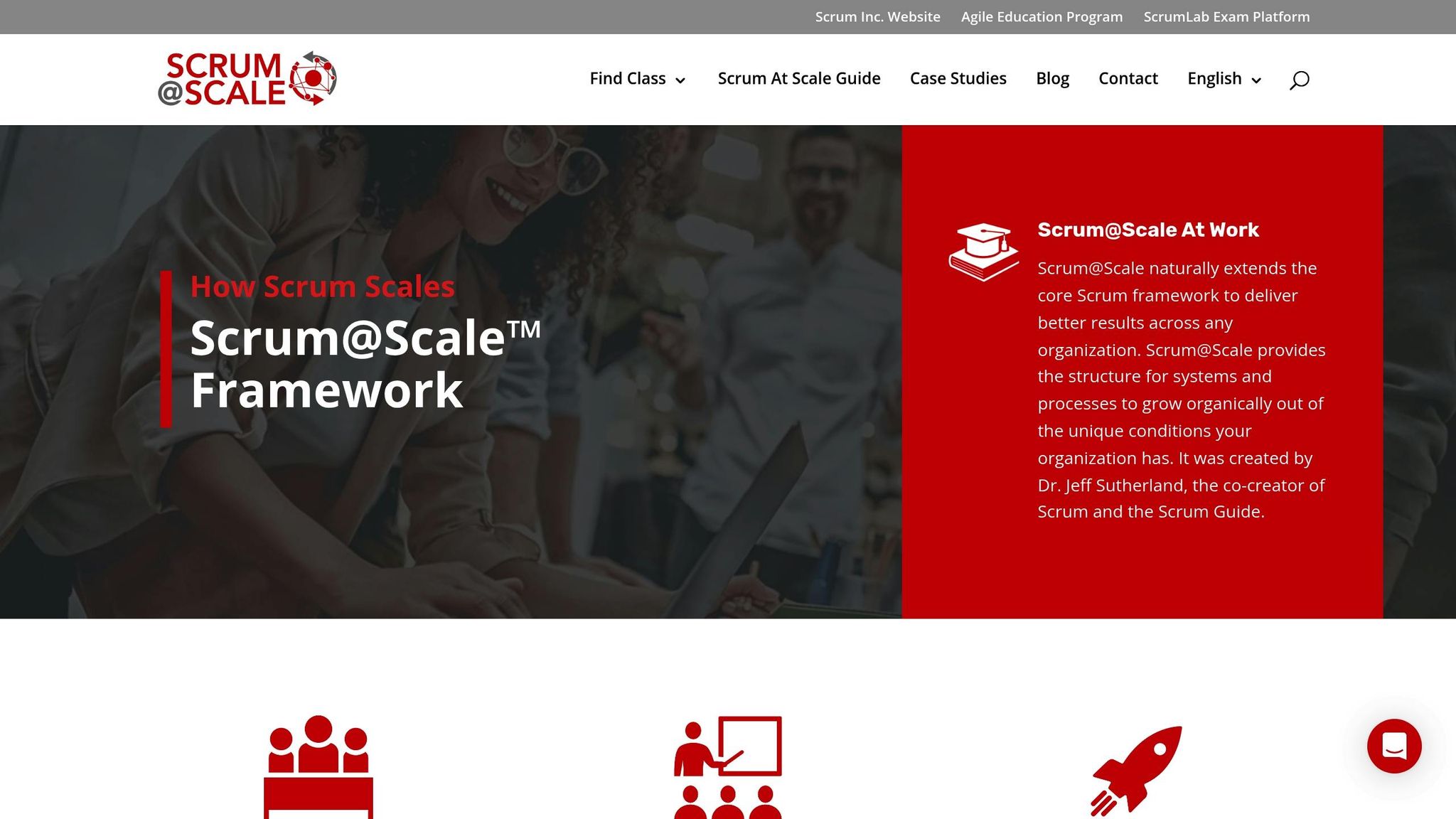
Scrum@Scale is an agile framework designed to help organizations grow while staying nimble. It takes the core principles of agility and applies them across the entire organization, fostering better team coordination without losing the flexibility that makes agile so effective. This framework allows teams to operate independently while staying aligned with larger strategic goals, making it a great fit for established companies managing multiple interdependent teams.
Core Focus Area
The main goal of Scrum@Scale is to enhance team coordination, enabling organizations to scale their operations efficiently – without introducing unnecessary bureaucracy.
Best Suited For
Scrum@Scale is ideal for companies that have moved beyond a single small team and are looking to expand their delivery capabilities. If you’re managing several teams that depend on each other, this framework provides a structured way to maintain both agility and alignment with your broader objectives.
This approach works well alongside other agile frameworks, ensuring your organization remains adaptable as it grows.
Framework Comparison
Now that we’ve broken down each framework, it’s time to see how they stack up in addressing your specific scaling challenges. Each framework approaches growth from a unique angle, tackling issues like creating repeatable processes, testing new ideas, aligning priorities, and improving team coordination.
- The Scaleup Methodology: Focuses on building systematic processes to sustain growth, ideal for those with a proven concept ready to scale.
- The Lean Scaleup Framework: Centers on small-scale experiments to validate ideas before committing large resources, reducing risk in the process.
- The 4 DECISIONS™ Methodology: Simplifies scaling by zeroing in on four key areas: people, strategy, execution, and cash flow.
- The Seven-Step Business Scaling Framework: Offers a phased, step-by-step approach to identify your current stage and map out a clear plan for expansion.
- Scrum@Scale for Organizational Growth: Designed to improve coordination and agility across multiple teams, making it a strong choice for complex, growing organizations.
These summaries highlight the strengths of each framework, helping you match them to your current business needs. It’s worth noting that many experts mix and match elements from different frameworks to tackle multiple challenges simultaneously. The key is to choose the framework that aligns with your immediate priorities and adapt it as your business continues to grow.
Conclusion
Growing your business isn’t about finding a single, flawless approach. It’s about understanding where you are right now and identifying the specific challenges standing in the way of your progress. The five frameworks we’ve discussed each address different obstacles – whether it’s building efficient systems, testing new ideas without overspending, aligning your team’s priorities, or managing the complexity that comes with expansion.
Take a moment to assess your current situation. For example, if you’re earning revenue but lack solid systems, the Scaleup Methodology could be the right fit. Still figuring out market fit? The Lean Scaleup Framework helps you test ideas without unnecessary risk. Feeling buried under competing priorities like team alignment, strategy, execution, and finances? The 4 DECISIONS™ Methodology offers a structured way to focus.
The most successful businesses often combine frameworks to tackle challenges as they evolve. You might use Lean Scaleup principles to experiment with a new program while applying the Seven-Step Framework to plan your long-term growth. This kind of tailored approach connects strategy with action. The key is to start with the framework that addresses your biggest challenge right now, commit to it for 90 days, and track metrics that matter – whether it’s client acquisition costs, program completion rates, or revenue per employee.
FAQs
How can I choose the right framework to effectively scale my expertise?
To choose the right framework for expanding your expertise, begin by clearly defining your business goals and pinpointing any challenges you’re facing. Are you aiming to grow your audience, develop engaging courses, or streamline processes with tools like AI? Knowing what matters most to your business will help you narrow down the options.
Once you’ve clarified your priorities, assess how each framework aligns with both your skill set and the expectations of your audience. Focus on frameworks that offer practical applications, can be implemented without delay, and provide measurable outcomes. Ultimately, the ideal framework is one that complements your business model while helping you deliver greater value to your audience.
Can I mix and match elements from the frameworks to create a personalized strategy for scaling my business?
The frameworks discussed in the article are designed with flexibility in mind, allowing you to mix and match elements from various approaches to suit your specific goals, audience, and expertise.
By personalizing these strategies to fit your unique needs, you can tackle challenges more efficiently, simplify workflows, and achieve better results. Just make sure any modifications stay true to the core principles of the frameworks to maintain their effectiveness.
What challenges do businesses often face when using these frameworks, and how can they address them?
Businesses often face hurdles like shaping frameworks to fit their specific needs, keeping their audience consistently engaged, and smoothly integrating tools like AI into their operations. While these challenges can seem daunting, they’re entirely manageable with the right strategies.
Start by customizing frameworks to align with your goals and audience. A cookie-cutter approach rarely works – tailor solutions to address the unique aspects of your business. To boost audience engagement, focus on clear communication and interactive methods that genuinely connect with your target group. When it comes to adopting AI or other advanced tools, take it step by step. Begin by automating simple, repetitive tasks, then gradually explore more complex applications as you gain confidence. The key is maintaining a balance of consistency and flexibility to tackle these issues effectively and get the most out of your frameworks.
Related Blog Posts
- How to Create Systems That Scale Your Expertise
- Business Scaling Checklist for Experts
- 7 Ways to Scale Your Consulting Business Fast
- Coaching vs Consulting: Which Model Scales Better?
 Scale Your Expertise