
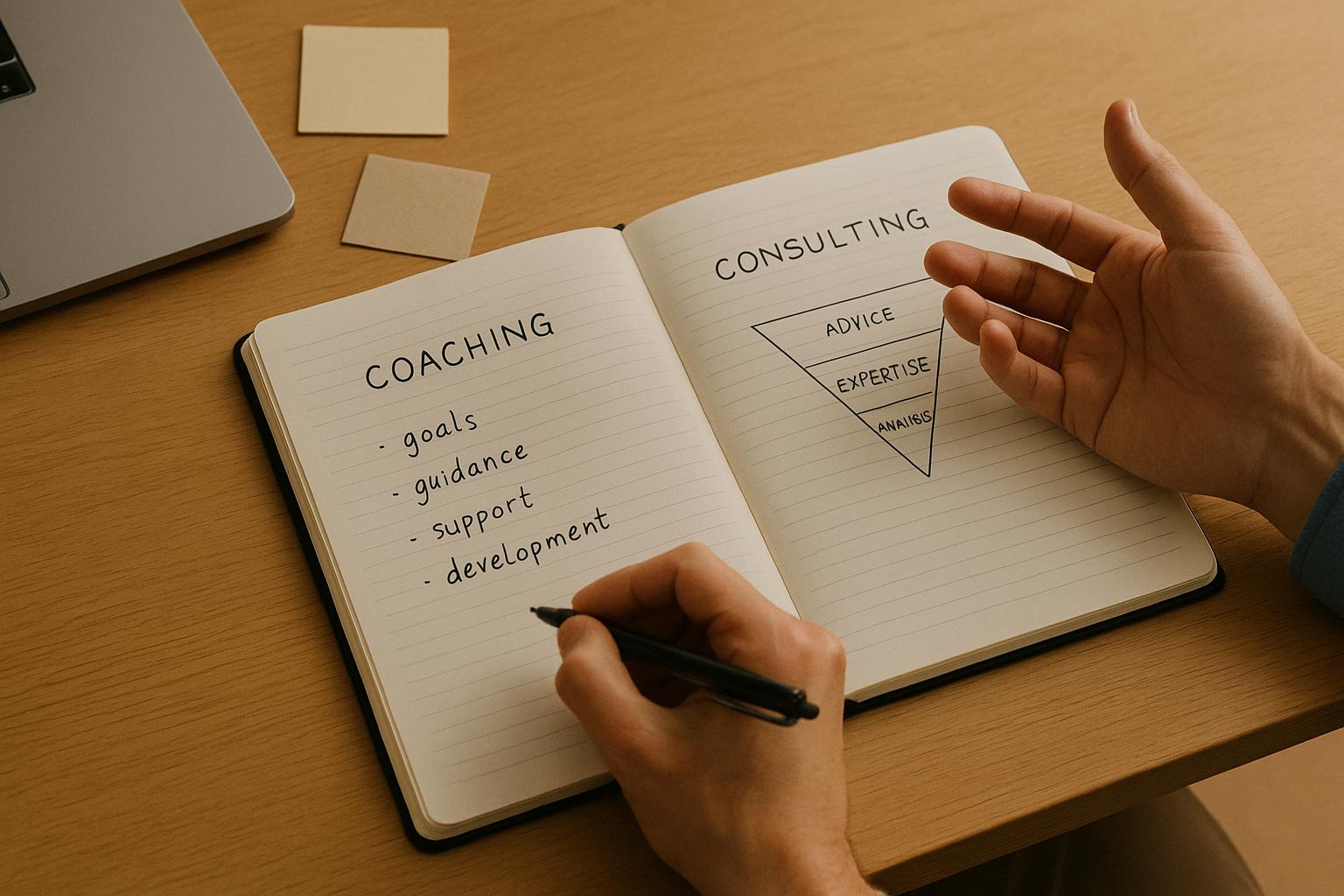
When deciding between coaching and consulting, the key question is: which model fits your goals, skills, and growth ambitions? Here’s the short answer:
- Coaching scales through group programs, memberships, and digital products, letting you serve larger audiences without increasing your hours. It offers recurring income but often requires a personal brand and consistent audience engagement.
- Consulting focuses on high-ticket, project-based work. It scales by raising fees, offering retainers, or building a team. While income per client is higher, it demands more customization and expertise, making delegation harder.
Quick Overview:
- Coaching: Best for broader reach, predictable income, and less time per client.
- Consulting: Best for premium pricing, solving complex problems, and delivering measurable outcomes.
Comparison Table:
| Metric | Coaching | Consulting |
|---|---|---|
| Typical Pricing | $200–$500/hour; $2,000–$10,000 for group programs | $150–$600/hour; $10,000–$50,000+ per project |
| Income Predictability | High with memberships/group programs | Moderate; depends on projects and retainers |
| Audience Size | Broad; scalable through groups, courses, etc. | Narrow; limited by project capacity |
| Time Per Client | Low for group formats; high for 1-on-1 | High; tailored solutions require more time |
| Delegation | Easier; frameworks can be taught | Harder; expertise-driven and highly customized |
Both models can scale, but the approach differs. Choose coaching if you want to grow through audience engagement and recurring revenue. Opt for consulting if you’re skilled at delivering tailored, high-value solutions and want to charge premium rates.
Key Differences Between Coaching and Consulting You Need to Know
How Well Coaching Scales
Coaching can absolutely scale, but it takes a shift in how you structure your services. The traditional one-on-one model has its limits, while group programs, memberships, and digital products offer opportunities to expand your reach and revenue. Here’s a closer look at how to build a business that can grow sustainably.
Revenue and Pricing in Coaching
One-on-one coaching can be highly lucrative, especially with premium pricing. Coaches often charge between $150 and $500 per hour, or bundle sessions into high-ticket packages starting at $5,000 or more. The downside? Your income is tied to the hours you work, creating a natural cap – even with high rates.
Group coaching changes the game by allowing you to work with multiple clients at the same time. These programs typically fall into the $1,000 to $3,000 range. For example, a 12-week program with 15 participants paying $2,000 each could generate $30,000 – a significant boost compared to one-on-one sessions.
Membership programs bring in recurring revenue, with monthly fees ranging from $50 to $500. While memberships can accommodate hundreds of people and provide predictable income, building a solid base of members takes time and consistent effort.
Digital products like online courses and eBooks are another scalable option, often priced between $50 and $500. While the revenue per sale is lower, these products can be sold indefinitely without requiring your direct involvement.
The next step? Implementing strategies to move from time-restricted models to scalable ones.
Ways to Scale a Coaching Business
Scaling your coaching business means stepping away from trading time for money. Shifting to group coaching or creating a membership community allows you to reach more people, generate recurring income, and expand your impact. Group coaching works especially well for topics that thrive on peer interaction and shared learning, while memberships offer resources, live Q&A sessions, and ongoing support.
Online courses are another powerful tool. By packaging your expertise into self-paced lessons, you give clients the flexibility to learn on their schedule – and free up your own time in the process.
Hybrid models that combine courses, group coaching, and memberships can serve a variety of client needs while maximizing your reach. These approaches not only help you scale but also address the income ceiling of one-on-one coaching. The key is to move from hourly pricing to models that focus on delivering outcomes.
Obstacles to Scaling Coaching
Despite its potential, scaling a coaching business comes with challenges – mostly tied to the personalized nature of coaching. Clients often expect individual attention, accountability, and tailored support, which limits how many people you can serve effectively.
One-on-one coaching, while lucrative, is time-intensive. Each client requires dedicated sessions, preparation, and follow-up, which restricts the number of clients you can take on – even at premium rates.
Group coaching offers scalability, but it comes with its own hurdles. Managing group dynamics, facilitating discussions, and ensuring value for everyone can be tricky. Larger groups may dilute the personal touch, which some clients are willing to pay extra to preserve.
Membership programs, while scalable, require constant updates and engagement to keep members interested. Without fresh content and regular interaction, retention rates can drop.
Digital products, on the other hand, need a larger audience to generate significant income. This often means investing heavily in marketing and building a loyal following.
Lastly, coaching often revolves around your personal brand. Clients choose you for your expertise and reputation, which can make delegating tasks or building a team difficult. In niches like trauma recovery or executive leadership, where personalized support is critical, scaling through group formats may not be as effective.
How Well Consulting Scales
Consulting grows by capitalizing on project-based work and expanding teams. The nature of consulting allows for higher revenue per engagement, while building a team increases capacity without adding more hours to your schedule. Let’s dig into how pricing strategies and specific approaches make this growth possible.
Revenue and Pricing in Consulting
Consulting rates tend to outpace coaching fees, reflecting the specialized expertise and measurable results consultants provide. On average, independent consultants charge anywhere from $150 to $600 per hour, with strategy consultants and those working with enterprise clients often commanding rates at the higher end.
Project-based pricing is a key driver of revenue. Instead of billing by the hour, many consultants offer fixed-price packages, which can range from $10,000 to $50,000 or more. For example, a marketing consultant might charge $25,000 for a three-month brand strategy project, while a business operations consultant could earn $75,000 for a six-month efficiency overhaul. These high-ticket projects allow consultants to generate significant income without being tied to hourly billing.
Retainer agreements are another lucrative option, offering predictable monthly income. These agreements typically range from $5,000 to $20,000 per month and may include ongoing strategic advice, quarterly planning sessions, and on-demand support. For instance, a consultant might secure $8,000 per month to provide continuous guidance and planning services.
What makes consulting especially scalable is that it’s not just about the time spent – it’s about the outcomes delivered. Consultants who solve critical business problems or help drive significant revenue growth can charge premium rates, enabling them to grow their income without increasing their workload.
Ways to Scale a Consulting Business
One of the most effective ways to scale is by building a team. Hiring junior consultants, project managers, or subject-matter experts allows you to manage multiple projects at once. This shifts your role from doing all the hands-on work to overseeing strategy and delivery, evolving your business into a multi-project operation.
Another straightforward way to scale is by raising your rates. As your reputation grows and your results speak for themselves, you can charge more. For example, doubling your rate from $200 to $400 per hour instantly doubles your revenue without adding clients or hours. The same principle applies to project fees – what you charged $15,000 for a few years ago could now command $30,000 based on your track record.
Retainer agreements also offer a path to scalability. Instead of constantly chasing new projects, retainers provide steady income, allowing you to focus on delivering results and planning for growth. For instance, five clients paying $8,000 monthly would give you a reliable income of $40,000 per month, even before taking on additional work.
Specialization is another way to scale efficiently. By focusing on a specific niche – like SaaS pricing strategies or compliance in healthcare – you can charge higher rates while working more efficiently. Deep expertise means less time spent researching and more time delivering proven solutions, enabling you to handle more clients in less time.
Some consultants also create productized services, offering standardized packages with clear deliverables and timelines. For example, a $5,000 website audit or a $15,000 sales process optimization package simplifies the sales process and makes it easier to delegate tasks to team members.
While these strategies increase capacity and revenue, they also come with their own challenges, which we’ll explore next.
Obstacles to Scaling Consulting
Scaling a consulting business isn’t without its hurdles. One of the biggest challenges is income volatility. Unlike retainers or membership models, project-based work can be unpredictable. You might experience a surge of clients one quarter and a dry spell the next, making it difficult to plan for growth or invest in your business.
Another challenge is client dependency. Relying on one or two major clients for a large portion of your income can be risky. For instance, if one client accounts for 60% of your $150,000 annual revenue, losing them would be a significant blow. Diversifying your client base requires time and effort, especially when you’re focused on delivering high-quality work to current clients.
Delegation is another sticking point. Consulting often requires solving complex problems that demand years of specialized knowledge. Unlike coaching, where frameworks can be taught and replicated, consulting clients expect tailored solutions with measurable results, such as improved efficiency or increased revenue. This makes it harder to delegate work without extensive training and oversight, as clients are paying for your specific expertise.
Sales cycles in consulting can also be lengthy, especially for high-ticket projects. It’s not uncommon to spend weeks or even months nurturing a prospect, preparing proposals, and negotiating terms before starting any work. This extended timeline can create cash flow challenges, particularly for newer consultants.
Finally, while productized services or courses can streamline operations, they come with risks. Clients hire consultants for custom solutions to their unique problems. Shifting too much focus toward standardized offerings can dilute your positioning, potentially undermining the premium pricing and close client relationships that make consulting so profitable in the first place.
sbb-itb-f54b9a0
Coaching vs Consulting: Side-by-Side Comparison
After examining how coaching and consulting scale on their own, let’s put them head-to-head. This comparison ties together revenue potential, time commitment, and operational factors to give you a clearer picture of which model might suit your goals.
Your choice depends on what resonates with your strengths, market, and aspirations. Some professionals thrive in the personal, transformation-focused nature of coaching, while others excel in the strategic, results-driven realm of consulting.
Comparison Table: Scalability Metrics
Here’s a breakdown of how coaching and consulting differ when it comes to scalability:
| Metric | Coaching | Consulting |
|---|---|---|
| Typical Pricing Range | $200–$500 per hour for 1-on-1 sessions; $2,000–$10,000 for group programs; $500–$5,000 monthly for memberships | $150–$600 per hour; $10,000–$50,000+ per project; $5,000–$20,000 monthly retainers |
| Income Predictability | High with recurring models like memberships and group programs; moderate with 1-on-1 monthly packages | Moderate to low; project-based work can fluctuate; retainers add stability |
| Potential Audience Size | Broad – can scale to hundreds or thousands through group programs, courses, and memberships | Narrow – limited by project capacity and the need for customization; generally serves 5–20 clients at a time |
| Time Investment Per Client | Low to moderate for scalable formats like group coaching and courses; high for 1-on-1 sessions | High – customized solutions require significant time for analysis, strategy, and execution |
| Revenue Growth Potential | Moderate to high – scales through audience growth and digital offerings, though limited by perceived value | High – scales through team expansion, rate increases, and high-ticket projects with measurable ROI |
| Client Acquisition | Faster – shorter sales cycles, especially for mid-priced offers; group formats onboard multiple clients at once | Slower – longer sales cycles for high-ticket projects; involves detailed proposals and negotiations |
| Delegation Difficulty | Low to moderate – frameworks and standardized approaches can be taught to team members | High – requires specialized expertise and customization, making delegation challenging |
| Dependency on Founder | Moderate – systems and teams can reduce reliance, but personal brand often drives growth | High – clients typically hire for the founder’s expertise, making it harder to step back without losing value |
| Operational Complexity | Lower – simpler delivery with digital products and standardized programs | Higher – customized projects involve multiple stakeholders and require more coordination |
Let’s break this down further to understand how these differences impact your business approach.
Coaching often provides more predictable income through recurring formats like group programs or memberships. It also allows you to reach a broader audience with less time investment per client, particularly when leveraging digital products. On the flip side, consulting offers higher earnings per client through premium, high-ticket projects but typically serves fewer clients due to the need for tailored solutions.
When it comes to scaling, coaching relies on expanding audience reach with the same core offerings. Consulting, however, scales by increasing fees, building a team, or taking on larger, more complex projects. Both models can generate impressive income, but the strategies to achieve growth are quite different.
Client acquisition is another area where coaching often has the edge. For example, a $3,000 group coaching program might only require one discovery call to close the deal. In contrast, landing a $30,000 consulting project could take months of relationship-building, proposals, and negotiations. This difference affects cash flow and the speed at which you can grow your business.
Delegation is generally easier with coaching because frameworks and processes can be documented and taught to others. Consulting, however, demands a high level of expertise and customization, making it harder to delegate without compromising quality or value.
Operational complexity also varies. Coaching tends to be more straightforward, especially when offering standardized programs or digital products. Consulting, on the other hand, often involves managing multiple stakeholders and juggling complex deliverables, which requires robust systems as you scale.
Ultimately, neither model is inherently better – it all comes down to what you’re optimizing for. Coaching excels in scalability, audience reach, and recurring revenue, while consulting shines in premium pricing, solving intricate problems, and delivering high-impact results. Your decision depends on whether you prioritize breadth of impact or depth of engagement, steady income or high-ticket projects, and simplicity or premium positioning.
Combining Coaching and Consulting
Why choose between coaching and consulting when you can combine the best of both? Many professionals are finding success by blending these two approaches into a hybrid model. This strategy allows you to deliver quicker results while still fostering the personal growth and transformation that coaching provides.
The hybrid approach caters to the growing demand for services that merge expert advice with personal development. Clients today want solutions that not only provide clear answers but also guide them toward self-improvement. Let’s dive deeper into how this model works and why it stands out.
What the Coach-Consultant Hybrid Model Is
The hybrid model is all about flexibility. It combines expert guidance with opportunities for personal exploration. Instead of sticking rigidly to one method, you adapt based on what your client needs at the moment. For instance, you might offer specific strategies like a consultant when a client is stuck on a technical issue. At other times, you might take on the role of a coach, asking thoughtful questions to help them uncover their own solutions – especially when it comes to leadership growth or overcoming mindset challenges.
As Luisa Zhou explains:
"But with coach-sulting, I give my clients a few of the answers in order to get them faster results. This approach allows you to help clients reach their goals more quickly and effectively and see more sustainable results." – Luisa Zhou
This model is particularly effective for consultants who want to build longer-term relationships with their clients. Instead of wrapping up after delivering a strategic plan or implementing a system, you can transition into coaching to help the client maximize those results. This not only enhances the value you provide but also creates opportunities for recurring revenue streams.
Professionals often structure their hybrid services within clear frameworks. Some start with consulting and then add coaching as a follow-up, while others take a more integrated approach – offering "coaching-infused consulting" or "consulting-informed coaching." These frameworks help clients progress faster while keeping the process structured.
When it comes to pricing, hybrid services usually reflect the combined value of both components. You can charge consulting fees as a flat rate or hourly, while offering coaching sessions separately. Alternatively, bundling both into a single package can provide clients with a comprehensive solution that includes both strategic insights and ongoing support.
Pros and Cons of the Hybrid Model
The hybrid model has plenty of advantages, but it’s not without its challenges.
The Benefits
- Premium pricing: Combining consulting and coaching allows you to charge higher fees because you’re delivering a more comprehensive solution. Clients value the mix of expert advice and personalized guidance.
- Multiple revenue streams: From flat project fees to recurring retainers, group programs, and even digital courses, the hybrid model gives you several ways to earn.
- Broader market appeal: Some clients lean toward consulting, others prefer coaching, and many appreciate a blend of both. By offering a hybrid service, you can attract a wider range of clients.
- Stronger client relationships: This approach often extends engagements beyond one-off projects, increasing the lifetime value of each client.
The Challenges
- Skill mastery: To succeed, you need to excel at both consulting and coaching, which takes time and practice.
- Managing expectations: Clients may sometimes expect you to act solely as a consultant, delivering ready-made solutions, or as a coach, focusing entirely on self-discovery. You’ll need to set clear boundaries and communicate the scope of your services effectively.
- Operational complexity: Customizing your approach for every client can make scaling your business difficult. Without clear systems and standardized packages, you risk burnout – especially if you’re running a smaller operation.
To navigate these challenges, it’s crucial to establish clear systems and boundaries. Define your service offerings, price them appropriately, and communicate those details to clients upfront. Standardized packages that combine consulting and coaching can help you maintain consistency while still offering flexibility.
The hybrid model works best when your expertise naturally spans both strategic problem-solving and ongoing support. Whether you’re helping clients grow their business, explore new markets, or develop leadership skills, this approach provides a well-rounded solution that neither coaching nor consulting could deliver on its own.
For those aiming to maximize income while keeping their services flexible, this model offers plenty of opportunities. With the right strategy, professionals can achieve six- or seven-figure incomes through high-ticket projects, recurring coaching retainers, group programs, and digital products.
The secret? Keep it simple. Start with one core hybrid service that’s easy to explain and deliver. Once you’ve refined your process, you can expand into more complex offerings – without overwhelming yourself or your clients.
Choosing the Right Model for Your Business
Summary of Scalability Differences
When it comes to scaling your business, consulting and coaching offer distinct paths, each with its own set of advantages and challenges. Consulting typically scales through high-ticket, project-based work. While you can charge top-tier rates for your expertise, your income is closely tied to the number of projects you can take on at any given time. Essentially, the more projects you handle, the higher your earnings – but this also means your workload increases proportionally.
Coaching, on the other hand, lends itself more naturally to scalability. By leveraging group programs or digital products, you can serve multiple clients simultaneously. Although individual coaching sessions might bring in less per hour compared to consulting, group coaching, online courses, or membership models allow you to grow your business without a matching increase in effort.
Operationally, these models differ as well. Consulting often requires a high level of customization for each client, meaning you’re frequently starting fresh with every new engagement. Coaching, however, benefits from repeatable systems and frameworks that can be applied across a variety of clients, making it easier to streamline and delegate as your business grows.
Another key difference is income consistency. Consulting income tends to ebb and flow with project cycles, whereas coaching models that rely on recurring revenue streams – like memberships or subscription-based courses – offer more predictable monthly earnings.
Matching Your Model to Your Strengths
The right model for your business depends less on which is "better" and more on what aligns with your strengths and preferred way of working. If you thrive on creating tailored, short-term solutions, consulting might be your best fit. But if you’re drawn to helping clients achieve long-term transformations, coaching could be the way to go.
Your broader business goals are another critical factor. If maximizing income while minimizing active working hours is your priority, coaching’s scalability through group programs and digital products provides a clear advantage. For instance, a well-designed group coaching program can serve dozens – or even hundreds – of clients at once, generating significant revenue from a single offering. By contrast, consulting often requires either a steady flow of new projects or building a team to manage growing demand.
Your expertise also plays a role. Consulting typically demands deep, specialized knowledge in a specific field, positioning you as the go-to expert with definitive answers. Coaching, however, is more about facilitation – helping clients uncover their own solutions. This means you don’t need to be the top expert in every industry nuance. Many successful coaches work across multiple sectors because their value lies in the process, not just the content.
For those who excel at both client-specific problem-solving and broader transformation, a hybrid approach can be a powerful option. Aligning your model with your strengths is the first step; the next is creating systems that support growth.
Building a Scalable Expert Business
Scaling your business requires well-designed systems and smart use of resources. Both consulting and coaching can lead to significant income growth, but the key is to define what scalability looks like for your chosen model and structure your processes accordingly.
For consultants, scaling often involves moving away from trading hours for dollars. This could mean developing standardized tools, frameworks, or training programs that deliver consistent results with less effort. Some consultants grow by building a team and transitioning into an agency model, while others focus on landing higher-value, strategic projects instead of smaller engagements.
Coaches typically scale by expanding their reach rather than their hours. What might start as one-on-one coaching can evolve into group programs, online courses, mastermind groups, or membership sites. These formats allow you to serve a larger audience without a corresponding increase in workload.
Technology is a game-changer for scaling both models. Automating routine tasks – like scheduling, client onboarding, or email follow-ups – frees up your time to focus on revenue-generating activities. The right tools can make scaling not only possible but also far more efficient.
Ultimately, the cornerstone of a scalable business is clear positioning. Whether you’re a coach, consultant, or a blend of both, having a focused area of expertise allows you to attract ideal clients, command premium rates, and develop repeatable processes. Specialists often find it easier to package their services and grow their businesses, while generalists may struggle to articulate a clear value proposition.
Start by choosing the model that aligns with your strengths and goals. Then, build systems that let you serve more clients without increasing your workload. Whether it’s through group programs, proprietary frameworks, team-building, or multiple income streams, scaling is all about working smarter, not harder.
FAQs
How can I shift from one-on-one coaching to scalable group programs or digital products?
Scaling from one-on-one coaching to formats that reach a larger audience requires some thoughtful planning. Begin by pinpointing the services or expertise your clients value most, and think about how you can tailor these for a wider group. For group programs, craft a well-structured curriculum that tackles the common challenges your clients face. If you’re leaning toward digital products like online courses or eBooks, focus on creating content that’s practical, engaging, and easy for users to navigate on their own.
To make scaling manageable, rely on tools like learning management systems for hosting courses or webinar platforms for group coaching sessions. Automating tasks such as scheduling and payment processing can save you time and energy, letting you focus more on delivering quality. Throughout the process, prioritize clear communication and regular interaction to ensure your services remain top-notch as your audience grows.
What should I consider before building a team for my consulting business?
When deciding if building a team is the right move for your consulting business, it’s essential to weigh factors like scalability, costs, and your long-term goals. A team can allow you to take on more clients and expand your offerings, but it also introduces new challenges – think payroll, training, and day-to-day management.
Ask yourself if your current business model and revenue can realistically support additional team members. Consider the specific roles you’d need to fill, such as administrative assistants, junior consultants, or specialists, and how these roles complement your expertise and meet client needs. Starting small by outsourcing certain tasks can be a smart, lower-risk way to explore this path before committing to permanent hires.
The key is to ensure that building a team aligns with your vision for growth while continuing to deliver the same level of quality and value your clients expect.
How can I create a hybrid coaching and consulting model to boost client results and grow my revenue?
To create a hybrid coaching and consulting model, blend the best of both worlds. Use consulting to deliver expert advice and practical solutions for immediate challenges, while incorporating coaching to help clients build the skills, mindset, and strategies they need for lasting success.
This approach lets you tackle short-term problems while equipping clients to maintain their progress over time. For instance, you could start by providing a customized plan (consulting) and then support the client as they implement it, focusing on skill development and long-term strategies (coaching). This not only boosts client outcomes but also opens the door to ongoing revenue and stronger client relationships.
Related Blog Posts
- 7 Ways to Scale Your Consulting Business Fast
- Ultimate Guide to Scaling Professional Services
- How to Build Diagnostic Tools for Clients
- Top 10 Tools for Scaling Expert Businesses
 Scale Your Expertise