

Your value proposition is the key to connecting your customers’ needs with the solutions you offer. It’s the foundation of your messaging, influencing how effectively you attract and convert potential clients. Here’s why it matters and how to refine it:
- What it is: A clear statement of the benefits your service provides, the problems it solves, and what sets you apart.
- Why it’s important: Research shows a well-defined value proposition can boost conversions significantly – examples include a 145% increase from better homepage messaging and a 300% jump from focusing on results.
- Core components: Understand customer jobs (functional, social, emotional), pains, and gains. Align these with your solutions, emphasizing pain relievers and gain creators.
- Steps to refine: Research your audience, identify your differentiators, and define measurable outcomes like cost savings or time reductions.
- Testing and improvement: Use A/B testing, customer feedback, and frameworks that amplify expert impact to continuously refine your messaging.
A strong value proposition isn’t static. It evolves with customer needs, market trends, and competitive landscapes. Start by focusing on clarity, relevance, and measurable results to make your messaging resonate.
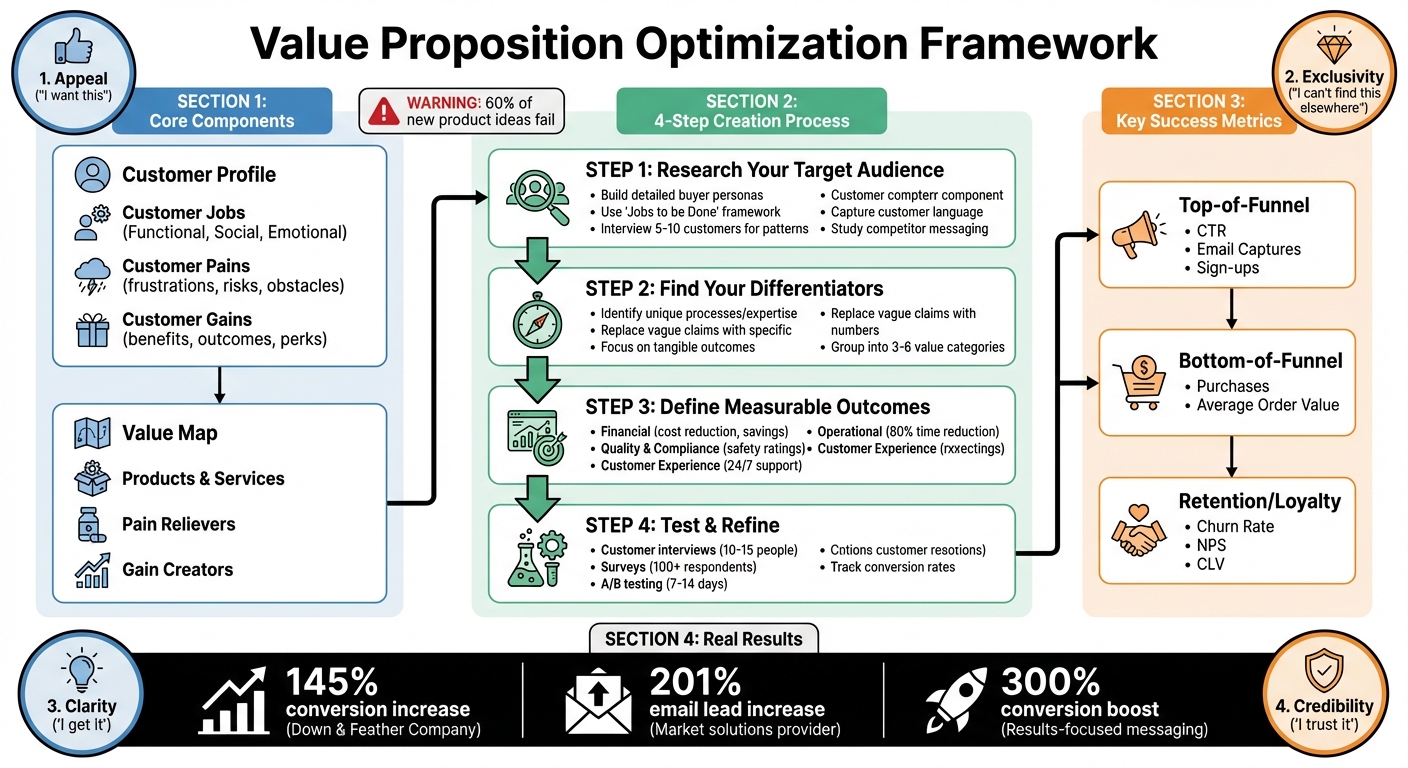
Value Proposition Optimization Framework: 4-Step Process
Strategyzer‘s Value Proposition Canvas Explained
Core Components of a Value Proposition
A strong value proposition bridges what your customers aim to achieve with how your solution helps them get there. It aligns the Customer Profile – which includes customer jobs, pains, and gains – with the Value Map, detailing your products and services, pain relievers, and gain creators. Let’s break down how to pinpoint customer needs and align your solutions effectively.
Customer Jobs, Pains, and Gains
Understanding your customers starts with identifying what drives them. Customer Jobs are the tasks, challenges, or goals they want to accomplish. These jobs fall into three categories:
- Functional: Completing a specific task or solving a problem.
- Social: Enhancing status or reputation.
- Emotional: Seeking satisfaction, security, or peace of mind.
While functional jobs are often the easiest to spot, the real game-changers often lie in addressing deeper social and emotional needs.
On the flip side, Customer Pains refer to the negative experiences, risks, or frustrations customers encounter before, during, or after trying to complete a task. These could include high costs, inefficiencies, or obstacles. Meanwhile, Customer Gains represent the benefits they expect or desire – whether it’s better functionality, cost savings, or even unexpected perks.
To make the most impact, rank these pains and gains by their relevance and intensity. This prioritization helps you focus on what matters most to your customers.
Matching Solutions to Problems
Once you’ve mapped out customer needs, tailor your Value Map to address their top priorities. Start with your Products and Services, but focus on the elements that truly set you apart:
- Pain Relievers: How your solution eliminates frustrations or solves specific problems.
- Gain Creators: The ways you deliver the outcomes your customers are looking for.
Zero in on the top three pain points that align with your strengths. This ensures your offering stands out and resonates with your audience.
Example: In June 2021, a market solutions provider shifted its messaging from offering "500 free leads" to highlighting its "most comprehensive and accurate lead database." This claim was backed by a team of 600 researchers and 26 million verification calls annually, resulting in a 201% increase in email leads.
This example shows how tailoring your message to meet customer needs – like reliable, verifiable data – can lead to a dramatic boost in engagement. By emphasizing measurable outcomes, you build trust and demonstrate value.
How to Create Your Value Proposition
Crafting a strong value proposition requires a step-by-step approach that digs into what your customers truly need and highlights how scaling expertise meets those needs. This involves thorough research, identifying what sets you apart, and defining clear, measurable outcomes.
Research Your Target Audience
Start by understanding who your ideal customers are – and just as importantly, who they aren’t. A message that tries to appeal to everyone often ends up resonating with no one. Use the "Jobs to be Done" (JTBD) framework to focus on the problem your customer is trying to solve, rather than just listing product features.
Capture the language your customers use to describe their challenges and your solutions. This "customer voice" can become a powerful tool to attract future prospects. Gather insights from internal teams like R&D, Sales, and Customer Support to identify all perceived points of value. Build detailed buyer personas using real data, covering job roles, pain points, motivations, and communication preferences. Interview enough customers to find 5–10 recurring patterns, ensuring your personas are well-rounded.
In 2010, Warby Parker’s founders addressed the high cost of eyewear by offering affordable designer frames and a social mission – donating a pair for every purchase. This approach helped them hit their first-year sales goal in just three weeks.
Study your competitors by signing up for their newsletters or email flows to spot gaps in their messaging. Use card-sorting exercises to test which benefits resonate most with your audience, narrowing down the options to a short list. For multiple propositions, Max-Diff studies can help rank the most and least important benefits, giving you a clear hierarchy.
Once you know your audience inside out, you can focus on what makes you stand out.
Find Your Differentiators
True differentiation comes from offering something no one else can. Your value proposition should be appealing, clear, and believable. Avoid generic claims like "better service" or "expert team." Instead, dig deeper into how you’re better – whether that’s through unique processes, specialized knowledge, or proven experience.
Look at your success stories and ask, "What do we celebrate most?" These wins often reveal your real differentiators. Replace vague statements with specific numbers. For example, instead of saying "widest selection", say "134 customizable attachments across 17 models".
In June 2021, a lead generation company shifted from generic claims like "most accurate mailing lists" to specific, verifiable proof: "We have a team of 600 researchers that verify data daily and make over 26 million verification calls a year." This change boosted their email capture rate by 201%.
Focus on outcomes – what tangible results or transformations do your customers experience? Group your value points into 3–6 categories (e.g., convenience, quality) and test which resonates most with your audience. Avoid over-the-top language like "best" or "world-class." If your proposition relies on hype, it’s likely not well-defined.
Once you’ve clarified your unique strengths, it’s time to back them up with measurable outcomes.
Define Measurable Outcomes
Quantify your results. Specific numbers like "80% time reduction" or "free shipping" are far more persuasive than vague promises of "convenience". These measurable outcomes often fall into categories such as:
- Financial: Examples include reduced costs or targeted savings.
- Operational: Think time saved or improved productivity.
- Quality and Compliance: Metrics like safety ratings or compliance guarantees.
- Customer Experience: Features like 24/7 support or clear return policies.
Every claim should be backed by proof – case studies, sales data, or third-party certifications. Use the XYZ formula to simplify your proposition: "We help [X: Target Customer] do [Y: The Job/Action] by [Z: The Solution/Product]".
Explore your "About Us" or FAQ pages for hidden gems – like the number of successful deliveries or specific quality benchmarks – that reinforce your message.
In June 2008, the Down & Feather Company partnered with the MECLABS Institute to redesign its homepage. By replacing vague claims with its "Perfect Pillow Policy", which offered free pillow firmness adjustments for a year, the company saw a 145% increase in conversion rates.
Test your messaging with pay-per-click ads by creating 3–5 variations emphasizing different measurable outcomes. Track which metric – price, speed, or quality – drives the highest click-through rate. Keep in mind, 86% of business buyers are more likely to purchase from companies that understand their goals, yet 59% say most salespeople fail to do so.
sbb-itb-f54b9a0
Testing and Refining Your Value Proposition
Once you’ve defined your value proposition, the next step is to test and fine-tune it. It’s not enough to assume your messaging will resonate – real-world feedback is essential. Keep in mind that what customers say and what they do can often differ. That’s why it’s important to combine verbal feedback, like interviews and surveys, with behavioral data from A/B tests and analytics.
Customer Feedback and Interviews
Start by conducting interviews with 10–15 potential customers to gather qualitative insights. Avoid hypothetical questions like “Would you buy this?” Instead, focus on fact-based questions that uncover real behaviors. For example, ask, “When was the last time you tried to solve this problem?”.
Steve Blank, a renowned entrepreneur, emphasizes: "You may be smart, but you are not smarter than the collective intelligence of your potential customers".
To identify broader trends, deploy surveys with at least 100 respondents to ensure statistical reliability. Rather than presenting abstract ideas, showcase your value proposition using wireframes or landing pages to mimic real-world interactions. Before launching your interviews or surveys at scale, test your scripts to weed out unclear or biased language.
A/B Testing Your Messaging
A/B testing is a powerful way to determine which version of your messaging resonates best. Focus on high-traffic areas like your homepage or lead-generation landing pages. Test one variable at a time – such as a headline, call-to-action, or image – so you can pinpoint what influences results.
Frame your tests with this structure: "If [change], then [result], because [insight]". Run each test for 7–14 days to account for traffic patterns and user behavior changes throughout the week. Resist the temptation to end tests early just because a tool shows “significance.” A study of 1,000 identical A/A tests found that 53.1% falsely reached 95% significance at some point, highlighting the risk of premature conclusions.
When testing, prioritize macro variants – like entirely redesigned pages – over small tweaks, such as button colors. Major changes often lead to significant improvements in conversions (50% to 300%), while minor adjustments rarely exceed a 2% boost.
Metrics to Track
To validate your improvements, monitor key metrics. Your primary focus should be on conversion rate – the percentage of visitors who complete your desired action, whether that’s signing up, downloading, or making a purchase. Use click-through rates (CTR) in pay-per-click ads to test 3–5 variations of your value proposition.
Track engagement metrics like time on page, scroll depth, and clicks on specific calls-to-action to gauge how well visitors connect with your message. Beyond immediate results, measure Customer Acquisition Cost (CAC) and Customer Lifetime Value (CLV) to ensure you’re attracting customers who bring long-term value. Tools like Net Promoter Score (NPS) and customer satisfaction surveys can also help you assess how well your message resonates over time.
Segment your data by device type, traffic source, and visitor type. A messaging variant might underperform overall but excel with a high-value audience segment.
| Metric Type | Examples | Purpose |
|---|---|---|
| Top-of-Funnel | CTR, Email Captures, Sign-ups | Measures initial interest and effectiveness |
| Bottom-of-Funnel | Purchases, Average Order Value | Measures financial impact and willingness to pay |
| Retention/Loyalty | Churn Rate, NPS, CLV | Measures long-term resonance and satisfaction |
If your website traffic is low, focus on metrics closer to revenue – like purchases or demo requests – rather than top-of-funnel clicks. Keep a detailed record of each test in a learning archive, documenting what worked, what didn’t, and why. This approach turns testing into a structured process for growth rather than a series of random experiments. Over time, these insights will guide further improvements to your value proposition.
Continuous Improvement Over Time
Your value proposition isn’t something you set and forget. It needs to evolve as markets shift, customer expectations grow, and competitors introduce new ideas. Think of it as a "living, breathing promise" that adapts to stay relevant and effective. By continuously refining your messaging, you ensure it resonates with your audience and stands out in a crowded market.
Here’s a stark reality: 60% of new product ideas fail because they don’t align with what customers actually need. Add to that the impact of regulatory changes or economic shifts, and a static value proposition can quickly become outdated.
Adapting to Market Changes
Staying ahead of market trends is key. Assign someone on your team to track monthly industry developments using a Trend Impact Dashboard. This tool helps you evaluate which trends are most relevant and require immediate attention.
In 2024, Phoenix Equity Partners raised $600M after CEO Jack Goodson led a value proposition overhaul. The project included a 50-page brand book and "The Phoenix Dictionary", reframing the firm as a bridge between trust and innovation. This clarified narrative became a standout factor during the investor process.
Shifts in consumer priorities also play a huge role. For example, ethical responsibility and sustainability are becoming more important to customers. In May 2025, Alon Dukorsky, founder of Circular Clothing Co., launched a resale platform that drew 26,000 site visits and 4,000 listed items. By pivoting from "guilt-driven" sustainability messaging to a "style-first" narrative, his team saw a 29% boost in ad click-through rates, all thanks to insights from 800 survey responses.
To keep your messaging clear and compelling, try the Five-Second Test: show your homepage to someone in your target audience and see if they can identify the main benefit in five seconds. If they can’t, it’s time to refine your message. Additionally, audit your top competitors to ensure your unique edge remains yours alone.
The secret to staying relevant lies in creating strong feedback loops.
Building Feedback Loops
Feedback systems help you keep your value proposition aligned with customer needs. Use a mix of qualitative insights (from interviews and focus groups) and quantitative data (from surveys and A/B testing). This combination uncovers both the reasons behind customer behavior and the measurable impact of your adjustments.
Over three months in 2025, Jason Rowe, Director of Hello Electrical, conducted 72 in-depth phone interviews to refine their value proposition for "busy professional homeowners." By shifting the focus from technical solutions to "peace of mind", they achieved a 10% increase in engagement during an A/B test of their online messaging.
Document your experiments with Test Cards and Learning Cards. These tools let you track hypotheses, metrics, and outcomes, turning customer feedback into actionable insights. For surveys, aim for at least 100 responses to ensure your data is reliable.
"Because a job to be done remains stable over time, it provides a North Star in innovation." – Clayton Christensen, Professor, Harvard Business School
The "Jobs to be Done" framework is another powerful tool. It focuses on understanding what specific "job" your customers hire your product to do. This core need often remains constant, even as technology or market conditions evolve.
Modern tools can take your feedback process to the next level.
Using AI and Modern Tools
AI simplifies the process of refining your value proposition, cutting manual audit time by up to 96% and enabling real-time adjustments that can boost conversions by 10–30%. These tools analyze your messaging continuously, replacing the need for periodic manual reviews.
For example, AI can scan your website to evaluate how effectively your messaging connects with different customer segments. Tools like Hotjar Intelligence, IBM Watson Analytics, Mutiny, Unbounce AI, Optimizely, and VWO can help you uncover behavioral patterns, personalize content, test variations, and validate ideas.
Start with pages that directly impact revenue – like pricing, solutions, or product pages – before moving to broader content. Use PPC ads to quickly test 3–5 variations of your value proposition summary. This method lets you identify what resonates most before committing to a full redesign.
While AI can uncover insights and generate ideas, human judgment is still essential. Use AI to handle the heavy lifting, but rely on your team to ensure brand voice and narrative consistency. The goal is to combine efficiency with the personal touch that builds trust.
For those looking for practical strategies to refine their value propositions, Scale Your Expertise (https://scale-your-expertise.com) offers frameworks and tools to help you integrate modern technology while maintaining clarity and authenticity.
Conclusion
Refining your value proposition isn’t a one-and-done task – it’s a process of constant evaluation, clear communication, and testing to ensure it resonates with your audience. The way you present your offer can make or break whether potential customers truly understand and connect with what makes you stand out.
Key Takeaways
To succeed, your value proposition needs to hit four essential points: Appeal ("I want this"), Exclusivity ("I can’t find this elsewhere"), Clarity ("I get it"), and Credibility ("I trust it"). If even one of these is missing, your offer might fall short, no matter how strong it is.
Start by identifying the exact problems your customers face and how your solution addresses them. Replace generic promises with specific, measurable examples – like saying "response time under 5 minutes" instead of just "quick support." Often, your most compelling points are tucked away on less visible pages, like the "About Us" section or FAQs, and need to be brought front and center.
"If I am your ideal customer, why should I buy from you, rather than your competitor?"
– MECLABS Institute
Testing has shown dramatic improvements in conversion rates – sometimes as high as 145% to 300% – when messaging is sharpened for clarity and trustworthiness. By consistently gathering feedback, keeping an eye on shifting customer needs, and using tools like AI, you can ensure your messaging evolves in step with your audience.
Next Steps
Want to take your value proposition to the next level? Here’s how to start:
- Audit Your Messaging: Score your current value proposition on appeal, exclusivity, clarity, and credibility. For each claim you make, back it up with specific, measurable evidence.
- Test Messaging with Value Buckets: Create 3–6 key focus areas, like price, quality, or convenience. Run small PPC campaigns with different ad variations to see what resonates most with your audience. Use the winning language to refine your landing pages, ensuring every element supports your core message.
- Gather Feedback: Conduct at least 10–15 in-depth customer interviews and aim for over 100 survey responses to gain actionable insights. Regularly revisit these insights to adjust your messaging as market trends and customer priorities shift.
For more tools and strategies to refine your value proposition while staying genuine, check out Scale Your Expertise. They offer resources to help you integrate modern technology without losing the personal connection that builds trust.
FAQs
What’s the best way to identify and prioritize customer needs and challenges?
To truly understand what your customers want and where they struggle, start with customer research. This can include interviews, surveys, or even casual conversations. The goal? To dig into their frustrations, challenges, and the outcomes they’re aiming for. Ask them questions like:
- What makes your tasks difficult or time-consuming?
- What risks or pain points do you encounter?
- What would make your experience smoother or more satisfying?
Once you’ve gathered this information, the next step is prioritization. Look for patterns – what issues come up most often? Which ones have the biggest impact on their success? Tools like the Value Proposition Canvas can help you visually map out customer pain points and desired benefits, giving you a clear picture of where to focus your efforts.
Finally, don’t just stop at identifying the problems – test your ideas. Use experiments or feedback loops to ensure your solutions actually address your customers’ top priorities. This way, you’re not just guessing – you’re delivering solutions that make a real difference.
What are the most effective ways to test and improve my value proposition?
To refine and strengthen your value proposition, start by collecting customer feedback through methods like surveys, interviews, or focus groups. These insights reveal what your audience truly needs and how well your offering matches their expectations.
Another effective approach is A/B testing, where you compare different versions of your value proposition. By tracking engagement and conversion rates, you can pinpoint which messaging connects best with your audience. Testing tools such as landing pages or mockups can also help validate your ideas in a practical way.
Lastly, keep a close eye on key metrics like engagement, conversion rates, and customer satisfaction after each test. This ongoing process ensures your value proposition stays relevant and resonates with your audience over time.
How can I keep my value proposition relevant as the market evolves?
To keep your value proposition relevant, you need to consistently evaluate and tweak it to reflect market trends, customer feedback, and shifting needs. Start by diving into market research to spot changes in customer preferences or shifts in your industry. This helps you fine-tune your messaging so it stays aligned with what your audience truly values.
Connect directly with your customers using tools like surveys, interviews, or feedback forms to get a clear picture of their changing expectations. Experimentation, such as A/B testing or small-scale trials, can reveal whether your value proposition still clicks with your audience. By staying ahead of the curve and regularly refining your strategy, you can ensure your value proposition stays effective and stands out in a crowded market.
Related Blog Posts
- Framework for Building Expertise-Based Value Propositions
- How to Scale Expertise with AI
- Why Positioning Matters for Coaches and Consultants
- Defining Core Expertise: Step-by-Step Guide
 Scale Your Expertise