

Positioning is the key to standing out in a crowded market. It defines how your business is perceived, who you serve, and why clients should choose you. Without clear positioning, you risk blending in, competing on price, and losing high-value clients. Here’s what you need to know:
- Specialization wins: Narrowing your focus to a specific niche makes you the go-to expert.
- Targeted messaging: Speak directly to your ideal client’s problems and goals.
- Value-driven approach: Highlight outcomes, not just services, to justify premium pricing.
- Proof builds trust: Use testimonials, case studies, and measurable results to back up your claims.
Clear, focused positioning translates to better clients, higher fees, and stronger growth. If your messaging feels generic or clients haggle over price, it’s time to refine your approach. Start by identifying your ideal client, crafting an expertise-based value proposition, and aligning your offers with your expertise.
Positioning Problems That Hold Coaches and Consultants Back
Generic Titles That Don’t Set You Apart
Using generic titles makes you blend into the crowd. These labels lump you in with countless others, leaving potential clients to focus on price rather than the unique value you bring to the table. Competing on price alone is a losing game, as it shifts attention away from what makes you stand out.
"A wide claim builds sales resistance because most people know that broad expertise is an oxymoron" – Blair Enns, founder of Win Without Pitching
Clients are savvy – they understand that genuine expertise comes from specialization. That’s why defining your niche and audience with precision is so important.
Vague Target Audience and Undefined Problems
Trying to appeal to everyone often results in connecting with no one. If your messaging doesn’t clearly identify a specific audience or address a distinct problem, potential clients are likely to scroll right past you. This lack of focus can lead to unanswered inquiries, empty inboxes, and discovery calls with prospects who don’t grasp the value you offer. In many cases, this leaves you overly reliant on referrals. Without a sharp and compelling message, your positioning becomes diluted, making it even harder to stand out.
Weak Value Proposition and Unclear Messaging
When your outcomes are unclear, clients see you as just another service provider rather than a worthwhile investment.
"The reason most consultants and agencies undercharge isn’t lack of skill – it’s unclear or undifferentiated positioning that makes them look interchangeable with competitors" – Ken Yarmosh
This lack of clarity not only forces you to justify your pricing but also opens the door to refund requests and negative feedback, potentially damaging your reputation over time.
"When you lack effective positioning, you’ll find yourself defending your consultancy to prospects more often than not" – Matt Hodkinson, founder of Tylt Consulting
No amount of sales expertise can compensate for unclear positioning. Without it, you’re left constantly explaining your value instead of confidently demonstrating it.
sbb-itb-f54b9a0
How Does Niching Impact A Consultant’s Market Positioning?
What Makes Positioning Work
Positioning isn’t about creating flashy campaigns or over-the-top branding. Instead, it’s about understanding your audience, defining the results you deliver, and proving your reliability. These principles lay the groundwork for the steps that follow.
Identifying Your Ideal Client
The clearer you are about who you serve, the easier it becomes to tailor your marketing, sales efforts, and services to their specific needs. When your messaging speaks directly to your audience, you become the obvious choice. This clarity helps you stand out from the sea of generic titles and vague promises.
Start by outlining the key traits of your ideal client. For instance, if you’re a content marketing consultant, your target might be mid-sized companies actively working to improve their online presence.
Take Vault Consulting as an example. They position themselves as "the nation’s leading accounting and research firm for nonprofits and associations." By combining two services for a niche audience, they carve out a distinct leadership role in their field.
To refine your focus, interview your top clients to understand their struggles and goals. Use these insights to create a "Lighthouse Client" profile – a clear representation of the clients you want to attract. This profile helps the right prospects see themselves in your messaging.
Writing a Clear Value Proposition
Your value proposition should answer one core question: What transformation do you deliver? Clients don’t pay for tasks or deliverables; they pay for results that solve their problems or improve their situation.
Start by defining your client’s "before" and "after" states. This shift from task-focused messaging (e.g., "I’ll conduct an audit") to results-focused messaging (e.g., "I’ll create a system that grows your leads by 30%") positions you as a trusted partner, not just another service provider.
To make your value proposition even stronger, connect features to benefits. Explain not just what you do, but why it matters to your clients.
"Ken Yarmosh built a $100,000+ monthly recurring revenue business in 2020 by targeting ‘established service-based solopreneurs stuck in delivery hell.’ His systematic approach to scaling without hiring allowed him to charge premium prices from the start."
Consider creating a unique name for your process or methodology, like "The ABCDE Way" or "E³volve System." This makes your approach easy to understand and sets it apart from competitors.
Once you’ve defined your value and process, it’s time to prove your claims with solid evidence.
Using Proof to Build Credibility
Proof is what transforms your value proposition from a claim into a trusted promise. Testimonials, case studies with measurable outcomes, and relevant credentials all help establish your credibility. This not only strengthens your positioning but also addresses the common issue of unclear messaging among many service providers.
High-growth firms often use research to highlight differentiators that are accurate, provable, and meaningful to their audience. For example, some companies emphasize key stats, like "9 out of 10 clients refer us to others", to reinforce their reliability.
Waymark takes it a step further by offering a risk-free guarantee. They promise a user-tested, interactive digital prototype within 30 days and back it up with their "Millennium Moonwalk Guarantee." If the client isn’t 100% satisfied, they refund the workshop fee. This kind of guarantee reduces the perceived risk for potential clients.
Be specific when showcasing results. Instead of saying, "I help businesses grow", say, "I helped three companies boost client retention by 20% in just 90 days." Concrete data like this not only makes your claims more believable but also strengthens your overall positioning.
How to Reposition Your Practice in 3 Steps
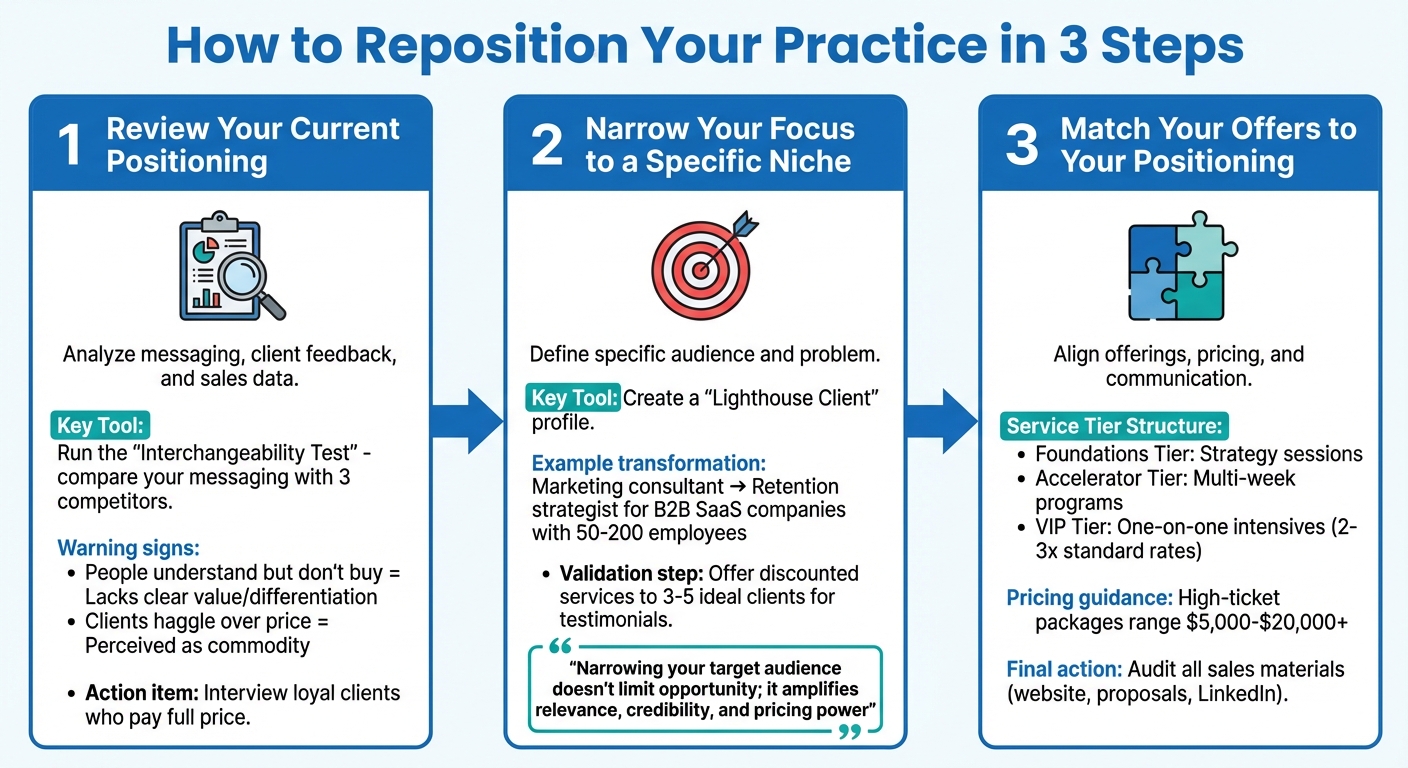
3-Step Repositioning Framework for Coaches and Consultants
Repositioning your practice doesn’t mean starting from scratch. It’s about refining what you already excel at and presenting it in a way that connects with your ideal clients. By making targeted adjustments, you can go from being just another option to being the go-to choice. Here’s a three-step plan to help you make that shift.
Step 1: Review Your Current Positioning
Begin by taking a hard look at your current messaging, client feedback, and sales data. This will help you identify where your positioning falls short. If your marketing sounds like your competitors, you’re blending in rather than standing out. Try the "Interchangeability" Test: compare your messaging with three competitors. If it’s hard to tell them apart, it’s time to revamp your approach.
Another key warning sign? When your team finds it easier to explain what you don’t do instead of clearly describing what you do offer. To dig deeper, interview your most loyal clients – the ones who happily pay full price. Ask questions like, “What prompted you to seek help?” and “What other options did you consider?” Their answers will reveal what they truly value about your services.
| Symptom | Problem |
|---|---|
| People understand what you do but don’t buy | Your messaging lacks clear value or strong differentiation |
| Clients haggle over price | Your services are perceived as a commodity rather than a unique solution |
Step 2: Narrow Your Focus to a Specific Niche
Once you know what clients value most, zero in on a specific audience and problem. Choosing a niche doesn’t limit your potential – it enhances your relevance and influence. Take Sargent & Lundy, for example. This engineering firm has focused exclusively on the power sector for over 130 years, capturing 8–10% of the U.S. market for their services. That kind of focus creates authority and pricing power.
To refine your niche, create a "Lighthouse Client" profile. This helps prospects instantly recognize themselves in your messaging. For instance, instead of calling yourself a generic "marketing consultant", try something like "retention strategist for B2B SaaS companies with 50–200 employees." To validate your niche, consider offering discounted services to 3–5 ideal clients. Collect testimonials and build case studies before fully launching your new positioning.
"Narrowing your target audience doesn’t limit opportunity; it amplifies relevance, credibility, and pricing power – making you the obvious choice for the right clients." – Ken Yarmosh, Business Mentor
Once you’ve defined your audience, make sure your services, offers, and messaging consistently reflect this focus.
Step 3: Match Your Offers to Your Positioning
Your offerings, pricing, and communication need to align with your updated positioning. Focus on selling outcomes, not just tasks or hourly work. For example, if you’re positioning yourself as a premium advisor for tech scale-ups, your pricing should reflect that level of expertise. High-ticket coaching packages often range from $5,000 to $20,000+ depending on the outcomes you deliver and the client’s budget.
Structure your services into clear tiers to meet different client needs. For instance:
- Foundations Tier: Strategy sessions for clients just starting out.
- Accelerator Tier: Multi-week programs for deeper engagement.
- VIP Tier: One-on-one intensives priced 2–3 times higher than your standard rates.
Finally, audit all your sales materials – your website, proposals, and LinkedIn profile – to ensure they align with your new positioning. Mixed messages or unclear pricing can confuse prospects and hurt your credibility. Remember, if your prices are too low or negotiable, clients may assume your services lack value.
Keeping Your Positioning Current
Once you’ve built a solid positioning framework, the work doesn’t stop there. To stay relevant and effective, your messaging needs regular updates. Markets evolve, client needs shift, and your expertise grows – your positioning should reflect these changes.
"Positioning is never set in stone. On the contrary… re-working your consultancy’s positioning is making progress. It’s a symptom of taking the consulting business to the next level." – Luk Smeyers, Founder of The Visible Authority
When to Review Your Positioning
It’s a good idea to review your positioning quarterly and plan for a more in-depth evaluation once a year. Keep an eye on key metrics like sales performance, proposal success rates, and the quality of leads you’re attracting. These indicators can reveal whether your messaging is still hitting the mark or needs adjustment.
"Every business should revisit messaging and positioning every year or so to make sure it’s still on point. Do it sooner if there’s a significant change in sales or the market." – M. Shannon Hernandez, Founder of Joyful Business Revolution
Adjusting to Market Shifts and New Tools
External changes like economic downturns, advancements in technology, or shifts in client expectations can quickly render old positioning ineffective. For instance, by 2025, 68% of full-time coaches are expected to use AI tools. If your clients are adopting new technologies or facing unfamiliar challenges, your messaging should highlight the human insights and empathy that set your services apart.
Market disruptions aren’t just challenges – they can also be opportunities. Businesses that adapt their positioning during tough times, like recessions, often come out stronger. When the landscape shifts, revisit your target audience and ask questions like: What new challenges are they facing? How has their daily work changed? Use these insights to adjust your messaging and stay relevant.
As you make these adjustments, stay true to your niche. Clear, focused positioning will always have a stronger impact than trying to be everything to everyone.
Staying Focused and Avoiding Dilution
While adapting to market changes, it’s essential to maintain clarity and avoid spreading your messaging too thin. A diluted message can weaken your marketing efforts, reduce pricing power, and even make it harder to attract the right team members.
Keep your positioning guidelines front and center. Update them if you notice 2–4 significant changes in your offerings or if your messaging starts to lose clarity. Specialization is key – when you’re laser-focused on who you serve and the problems you solve, you’ll naturally attract the right clients.
Conclusion
Positioning is the backbone of whether your coaching or consulting business attracts the right clients at the right prices. As April Dunford puts it:
"Marketing with weak positioning is like making an omelet with rotten eggs. Your cooking technique might be perfect but nobody wants to eat what you’re serving".
You can start improving your positioning right now. Begin by identifying your Lighthouse Client – the ideal client who benefits most from your work – and craft a value proposition that focuses on the transformation you deliver, perhaps by using frameworks that amplify expert impact. Support this message with proof that builds trust, and ensure every touchpoint – your LinkedIn profile, website, and beyond – aligns with this narrative. This consistency ensures your unique value shines through at every interaction.
Test your positioning regularly as you refine it. Share it through social media posts, discovery calls, or client conversations, and observe the results. Are you consistently attracting the right leads? Are prospects saying "yes" more often? If you’re encountering price objections or speaking to the wrong audience, see it as a sign to tweak your positioning. Real-world feedback is your guide to fine-tuning your message.
As your expertise grows and client demands shift, your messaging should adapt too. Matt Hodkinson, who has helped over 30 consultancies achieve standout positioning in under two years, emphasizes:
"Positioning isn’t static. Use this feedback to evolve your messaging as your consultancy grows and markets shift".
When your positioning is strong, the benefits multiply: smoother sales, better pricing power, and higher-quality leads. Stay focused on your niche, keep refining your message, and you’ll create a business that not only stands out but thrives.
FAQs
How do I figure out who my ideal client is to improve my positioning?
Identifying your ideal client is a game-changer when it comes to positioning yourself effectively. Why? Because it allows you to focus on the people who not only need your services but are also willing to invest in them. Start by asking yourself: “Who is the one person I’m perfectly suited to help with this specific problem?” This question shifts your mindset from trying to please everyone to zeroing in on a specific group that truly aligns with what you offer.
To shape your ideal client profile (ICP), think about these core elements:
- Demographics: What’s their age, location, income, or job title? These details can help you identify whether they’re in a position to afford your services.
- Psychographics: What drives them? What values, goals, or fears do they have that connect with the transformation you can deliver?
- Pain points: What challenges are they actively trying to solve? Maybe they’re stuck in their career or struggling to grow their business.
- Readiness to invest: Are they ready to take action and commit to a solution right now?
A great way to refine your ICP is by interviewing your best past clients. Look for patterns in their needs, behaviors, and goals, then create a clear and concise profile that captures the essence of your ideal client. Once you have that profile, test your messaging. Offer something targeted – maybe an ad or a specific promotion – and see who responds most enthusiastically. The group that connects with your offer the strongest is likely your ideal audience, giving you the clarity to position yourself as their go-to expert.
How can I create a strong value proposition for my coaching or consulting business?
To create an impactful value proposition, focus on clearly defining your audience, the problem you solve, and the unique outcomes you offer. Start by zeroing in on a specific group of people and pinpointing a problem you can solve better than anyone else. This sharp focus helps you grab attention and connect with the right clients.
Once you’ve nailed that down, craft a simple and direct statement like: "I help [your ideal client] achieve [specific outcome] so they can [enjoy this benefit]." Be sure to highlight what sets you apart – whether it’s a proven process, specialized knowledge, or a unique system.
The last step is to validate your value proposition. Get feedback from potential clients to see if it resonates. Test it on platforms like your website or social media, monitor responses, and tweak it as needed. A well-defined, client-centered value proposition will help position you as the go-to expert in your field.
How can I use proof to build credibility and stand out as a coach or consultant?
To build trust and reinforce your reputation, focus on presenting clear, measurable results and genuine validation of your work. Share specific achievements, like “helped 12 CEOs boost revenue by $250,000 in six months,” to showcase the impact you’ve made. Include detailed testimonials from happy clients, ideally with their name and role, to add a personal and credible touch.
Another effective strategy is to craft short case studies that outline your successes. Break them down into the challenge faced, the steps you took, and the results achieved. Don’t forget to feature endorsements such as media coverage, certifications, or awards prominently on your website and in marketing materials. These elements not only highlight your expertise but also strengthen your positioning statement by backing it up with solid proof. Demonstrating your results in this way can help you earn trust and attract higher-value clients.
Related Blog Posts
- 7 Ways to Scale Your Consulting Business Fast
- Coaching vs Consulting: Which Model Scales Better?
- Top 10 Tools for Scaling Expert Businesses
- How to Create a Signature Framework
 Scale Your Expertise