

Creating a signature framework can transform your expertise into a structured, repeatable system that solves specific client problems. This approach helps you stand out, command higher fees, and scale your business. Here’s how it works:
- What It Is: A signature framework is a clear process, typically with 3–7 steps, that organizes your methods into a system clients can follow.
- Why It Matters: It differentiates you from competitors, reduces price sensitivity, and enables scalability through courses, group programs, or licensing.
- Steps to Build:
- Define your niche and core problem.
- Analyze past successes to find patterns.
- Outline and group your process into phases.
- Choose a structure (e.g., roadmap, pyramid, or cycle).
- Name it clearly and use client-friendly language.
- Test, refine, and document your framework for consistent delivery.
A signature framework makes your expertise easier to understand, trust, and implement, positioning you as a leader in your field. Start by reviewing your past work to uncover the steps that consistently deliver results, then organize them into a process that clients can follow with confidence.
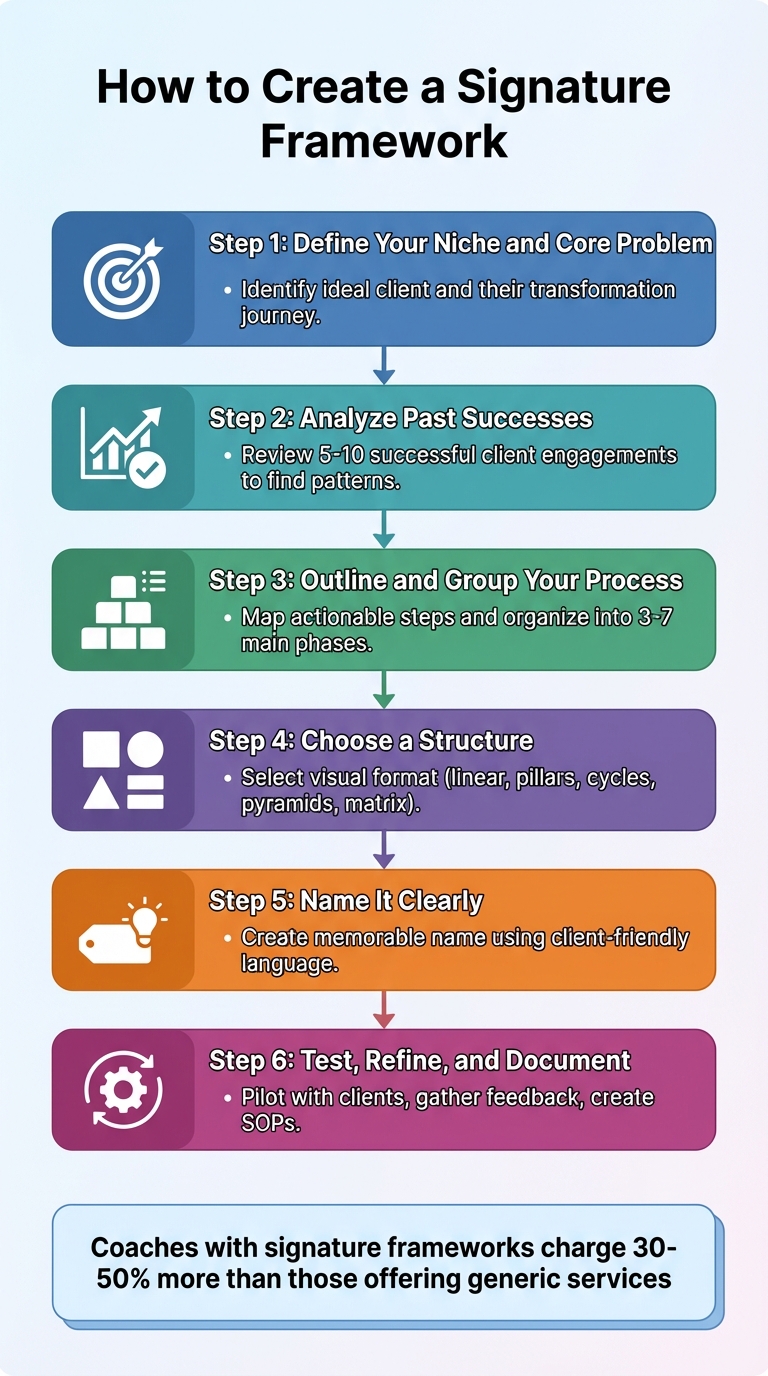
6-Step Process to Create Your Signature Framework
How to Create Your Signature System in 7 Steps
Define Your Niche and Core Problem
Before diving into building your framework, take a step back to clearly define your audience and the problem you aim to solve. This is what elevates your service from being just another option to becoming a sought-after solution.
Identify Your Ideal Client
Your ideal client occupies a specific space between where they are now and where they want to be. Pinpointing this gap is essential for crafting a framework that feels both relevant and impactful.
Think beyond basic demographics. Focus on their mindset and behaviors. For instance, your ideal clients might feel buried under years of disorganized notes, stuck in endless research with no clear direction, or trapped in the "time-for-money" cycle, where their income has plateaued. These individuals aren’t searching for generic advice or random tips – they’re looking for a system they can trust and implement.
Define the Core Problem and Desired Transformation
Chart the emotional journey your clients go through. What’s their "before" state? Maybe they’re frustrated, uncertain about their progress, or feel invisible in a crowded market. Now, imagine the "after" state: confidence, clarity, and being recognized as an authority.
"Clients aren’t buying your steps – they’re buying who they become."
- Geoff McDonald, Ideas Architect
Be detailed about the transformation you offer. For example, if your framework helps coaches stand out in saturated markets, the problem isn’t just low visibility. The real issue is that they blend in with competitors, which can lead to price wars and poor conversion rates. Without a clear plan, clients may feel lost, which can create anxiety and ultimately cause them to disengage.
Once you’ve mapped out this journey, reflect on your past successes to uncover proven strategies.
Audit Your Existing Work
Chances are, parts of your framework already exist. Take a close look at your most successful client experiences – 5 to 10 of them – and identify recurring patterns. What tools, exercises, or methods consistently led to breakthroughs? What natural steps did your clients follow, and what challenges did they overcome along the way?
Pay attention to the language your clients use to describe their experience. Their words can guide how you name and explain your framework. If you’re in a creative field, review your body of work to identify recurring themes or approaches. These patterns often form the backbone of your signature style.
Build and Structure Your Framework
Now that you’ve pinpointed your audience and the problem you aim to solve, it’s time to transform your expertise into a clear, repeatable system. This is where your scattered insights come together to form a structured process that your clients can follow with ease.
Outline Your Process
Begin by mapping out each step your clients need to take to achieve their desired results. Focus on actionable steps rather than just providing information – your goal is to guide clients toward success through concrete actions. To get started, try recording your explanation with a tool like Loom and transcribe it to capture your natural thought process.
As you review your successes, look for patterns – recurring actions, tools, or exercises that consistently deliver results. Arrange these steps in a logical order that builds momentum, turning your expertise into a system that clients can easily follow. Once you’ve outlined the steps, organize them into distinct phases.
Group Steps into Phases
After defining the steps, group them into 3 to 7 main phases. Why this range? Fewer than three phases might feel too simplistic, while more than seven can overwhelm clients and make the framework harder to remember. Each phase should represent a meaningful milestone, giving clients a clear sense of progress toward their ultimate goal.
"The best signature methods find a balance – providing enough structure to guide students while remaining flexible enough to address the messy reality of real learning."
Take inspiration from examples like speaker and coach Michelle Edelin. In August 2025, she reorganized her expertise using a "Framework Pyramid" approach. She grouped her methods into branded offerings under the suite "Speak Your Excellence", which included a workshop, a keynote titled "Activate Your Inner Excellence", and a team program called "Connect Your Excellence." Within weeks, her first workshop was booked.
When grouping your steps, think about the emotional journey your clients will go through. Each phase should bring them closer to clarity and confidence. For instance, a three-phase framework might follow patterns like "Diagnose, Design, Deliver" or "Clarify, Create, Convert." Using mnemonic devices can make your phases easier to remember and share.
Choose a Framework Structure
Once your phases are defined, choose a visual structure that complements your process and makes it easy to grasp. The right visual format can reinforce your message and build trust. Different structures work better for different types of processes:
| Structure Type | Best Used For | Visual Metaphor Examples |
|---|---|---|
| Linear / Stages | Clear start-to-finish journeys | Staircase, Roadmap, Bridge, Ladder |
| Pillars | Key components that stand independently | Building columns, Foundation stones |
| Cycles | Processes that repeat or evolve continuously | Wheel, Orbit, Flywheel |
| Pyramids | Hierarchies where foundational elements support the top | Maslow’s Hierarchy, Mountain |
| Venn Diagram | Overlapping concepts or niches | Ikigai model |
| Matrix / Grid | Categorizing based on two variables | Eisenhower Matrix, 2×2 Grid |
For example, psychologist Scott Barry Kaufman created a "Sailboat" framework as a modern take on Maslow’s Hierarchy of Needs. In his model, human needs are divided into two parts: the "hull" (representing security needs like safety and connection) and the "sail" (representing growth needs like exploration and purpose). This structure provides a fresh way to visualize psychological development.
sbb-itb-f54b9a0
Make Your Framework Easy to Remember and Market
Once you’ve structured your framework, the next step is making it stick in people’s minds. A framework that’s hard to explain or recall won’t gain traction, no matter how effective it is. Focus on three key aspects: a name that stands out, language that resonates with your clients, and clear, tangible deliverables.
Create a Clear Name
The name of your framework is its first impression – it should instantly convey its value. A strong approach is using a two-part name: a unique, concise title paired with a benefit-driven subtitle. For example, "Monetize: How to Double Your Profits with Your Signature System". Short, one-word titles are ideal for recognition and searchability. Longer names risk being forgotten or causing confusion when people try to find you online.
"The name is the sign above the door – it’s how people will remember it. A great name turns your signature method from generic to memorable."
- Geoff McDonald, Ideas Architect
Before finalizing, test your name by saying it out loud. Does it flow naturally? Does it suggest the transformation your framework offers? Consider using acronyms (like the P.A.U.S.E. Method) or alliteration (like the Story Sprint System) to make it more memorable. Above all, ensure it’s easy to pronounce and share.
Use Client-Friendly Language
While you might be fluent in technical jargon, your clients likely describe their challenges in simpler, everyday terms. Speak their language by focusing on outcomes rather than processes. For instance, instead of saying, "I will audit your systems", say, "I will identify three bottlenecks killing your conversion rate".
Pay attention to how your clients naturally talk about their struggles. Their words can inspire the names of your framework’s phases or steps. Brand strategist Annie Franceschi calls these "sticky phrases" – terms that are easy to remember and share. By aligning your language with theirs, you create a shared vocabulary that fosters connection and makes your ideas more relatable.
"The expert’s paradox is when your deep knowledge works against you. You overwhelm prospects by explaining too much too early. Instead of inspiring confidence, you confuse them with unnecessary details."
- Ken Yarmosh, Founder, Scalable Service Offers
Visual metaphors can also make abstract concepts easier to grasp. Words like "Bridge", "Compass", "Blueprint", or "Roadmap" instantly convey clarity and direction. Pair these with action-oriented verbs like "Clarify", "Organize", "Launch", or "Optimize" to create a sense of movement and progress.
Define Deliverables for Each Phase
Clients want to know exactly what they’ll get at every step. Vague promises can create doubt, but specific deliverables build trust. For each phase of your framework, clearly outline the tangible output – whether it’s a report, action plan, or roadmap – and explain why it matters to their goals.
Breaking your process into five to seven milestone-based steps can ease client anxiety by showing steady progress. Each deliverable should represent a meaningful step toward their desired transformation. This level of clarity not only reassures clients but also sets your framework apart from generic coaching. It’s one reason why coaches with signature frameworks often charge 30% to 50% more than those offering general advice.
| Phase | Deliverable | Client Benefit |
|---|---|---|
| Discovery | Ideal Audience Profile & Brand Voice Guide | Understand exactly who you’re targeting and how to connect |
| Strategy | Content Roadmap & Timeline | Replace guesswork with a clear, consistent plan |
| Execution | Engaging, On-Brand Content Assets | Attract and resonate with the right audience |
| Launch | Published Campaign & Performance Test | Identify what works and refine for better results |
| Growth | Performance Analysis Report | Stay effective with ongoing improvements |
When potential clients see clearly defined deliverables, they can quickly decide if your program is the right fit – saving time for both sides. This transparency also supports value-based pricing. If your framework can generate $100,000 in results, pricing it between $5,000 and $25,000 becomes a logical investment.
Test, Refine, and Implement Your Framework
Pilot and Gather Feedback
Start by testing your framework with a small group of clients. Instead of introducing it as a completely new approach, offer it as an enhancement to your current services. This way, you can collect valuable data without disrupting your revenue stream. The goal here isn’t just to confirm that your framework functions as intended; it’s to ensure it solves real problems for your clients in practical settings.
During the pilot, pay close attention to any friction points. Where do clients encounter challenges? Which concepts require repeated explanations? Which tools lead to the most impactful results? These insights will highlight the gaps between your theoretical framework and its actual implementation. Treat these issues like "defect reports", documenting their severity and the specific conditions that led to confusion or setbacks.
"This real-world testing often reveals gaps between your theoretical model and practical application. Make refinements based on this feedback before scaling."
To capture key moments, record your sessions using tools like Loom and transcribe them for detailed analysis. Share these recordings with experts for additional feedback to ensure you’re covering all bases.
Refine Based on Results
Once you’ve gathered feedback, focus on what clients are actually doing rather than what they know. Pinpoint the actions that directly lead to the desired outcomes. If one specific step consistently drives results, emphasize it. At the same time, streamline your framework by removing unnecessary steps that don’t contribute to meaningful change.
Consider merging similar phases or adding decision points where clients’ paths tend to diverge. Study the journeys of your most successful clients to identify the key actions that brought them results. If certain tools consistently lead to breakthroughs, make them central to your process. On the other hand, eliminate steps that feel redundant or cause confusion.
Think of your framework as a living document that evolves with your insights and market demands. When you make major updates, share them publicly. This not only reinforces your authority but also re-engages potential clients who may have hesitated in the past.
After refining your framework, translate it into standardized procedures to ensure consistency and scalability.
Turn Your Framework into Standard Operating Procedures
The final step is to transform your validated framework into a repeatable system. Create SOPs, templates, and checklists for every phase of your process. This ensures consistent delivery, whether you’re working with a new client or your hundredth. Define clear entry criteria (what must be in place to begin) and exit criteria (what success looks like) for each stage.
Develop visual aids like roadmaps or flowcharts to make your process easy to understand. A well-designed visual should enable clients to explain your method to others without your direct input. Standardize everything – deliverables, communication timelines, and milestones – so clients always know what to expect.
| Feature | Ad Hoc Delivery | Framework-Led Delivery |
|---|---|---|
| Pricing Model | Hourly or session-based; prone to price comparisons | Value-based; packages expertise into proprietary IP |
| Scalability | Limited by available hours; high burnout risk | Scalable with courses, group programs, and AI-driven support |
| Client Experience | Can feel vague or disorganized; lacks a clear structure | Provides clear milestones and consistent progress |
| Efficiency | Requires creating custom solutions for each client | Relies on a repeatable system for consistent quality |
Once your framework is fully documented, you can package it into multiple offerings. Create free lead magnets like checklists, low-cost digital products such as workbooks, group coaching programs, and premium one-on-one sessions. This builds a value ladder, allowing you to serve clients at different price points while preserving the integrity of your core process. Coaches with well-defined frameworks often charge 30% to 50% more than those offering generic services.
Conclusion
Key Takeaways
A well-designed signature framework does more than just set you apart – it simplifies every client interaction. By turning your expertise into a clear, repeatable system, you give clients something they can easily understand, trust, and follow. This approach moves you beyond competing on price or personality, positioning you as a leader with a proven process that delivers predictable results. In a crowded marketplace, that distinction is invaluable.
The financial benefits are clear. A structured framework allows you to charge higher rates. It also improves efficiency, giving you a reliable system that saves time while ensuring consistent outcomes. Plus, it opens doors to scaling your expertise through group programs, digital courses, or even licensing your methodology to others.
But it’s not just about revenue. A solid framework builds client trust. When clients can see a clear path to transformation, their confidence grows, and they’re more likely to stay committed. This shared framework also makes it easier for them to recommend your services to others.
With these benefits in mind, now is the time to take meaningful action.
Next Steps
Put these ideas into practice by starting with a focused review. Look at 5–10 of your most successful client engagements and identify the common patterns that led to success.
Then, distill those patterns into 3 to 7 key phases. This keeps your process simple enough for clients to follow while covering the necessary steps for transformation. Use a visual metaphor – like a bridge, pyramid, or roadmap – to make your framework easy to remember. Finally, give your framework a compelling name: a short, unique title paired with a subtitle that highlights the benefit.
For further support in refining your expertise and creating scalable systems, check out Scale Your Expertise. This platform offers actionable strategies for packaging your knowledge, improving delivery, and leveraging tools to grow your authority – without the risk of burnout.
FAQs
How can I choose the best structure for my signature framework?
To design the ideal structure for your signature framework, start by zeroing in on the result you want your audience to achieve. Pinpoint 3-5 action-driven words like "streamline," "build," or "transform," along with descriptive terms that capture the outcome, such as "efficient" or "empowered." This approach keeps your framework aligned with what your audience truly values.
Next, outline the logical steps of the client journey, breaking it into 5-6 clear phases. Select a structure that complements this journey – whether it’s a catchy acronym, a step-by-step guide, or a layered model. Make sure it’s straightforward, memorable, and connects with your core message or brand identity.
Lastly, test its effectiveness. Try explaining it in 30 seconds or less, or gather feedback from trusted colleagues to ensure it’s both clear and practical. Giving your framework a concise, engaging name that ties back to its purpose will help it stick in people’s minds.
What are the benefits of creating a signature framework?
A signature framework gives your expertise a distinct identity, setting you apart in your industry. By presenting your methods in a clear, branded system, you make it easier for clients to see the value you bring. This clarity not only builds trust but also positions you as a go-to authority in your field. The result? You’re more likely to attract high-value clients and can command higher fees, moving beyond the traditional "time-for-money" model.
On the inside, a signature framework works as a blueprint for your business operations. It simplifies your content creation, programs, and processes, ensuring everything runs consistently and efficiently. Its repeatable structure keeps you organized and focused, while also making your business easier to scale as you grow. Over time, this framework becomes a powerful asset, supporting your success for the long haul.
How can I make my framework easy for clients to understand and remember?
To make your framework both clear and easy to remember, focus on keeping it simple and well-structured. Break the process into 5-6 key steps that map out the client journey – think stages like onboarding, delivery, or transformation. Use concise, descriptive names for each step, such as "Set Goals" or "Launch Results", so they’re straightforward and easy to recall. Arrange these steps in a logical sequence that feels natural, and consider creating a visual aid, like a flowchart or acronym, to help reinforce the concept.
Stick to plain language and steer clear of industry jargon, ensuring that clients can quickly understand the framework. Test it out with someone unfamiliar with your work to ensure it’s easy to follow. Use the same names and order consistently in your communication to build recognition. Lastly, invite feedback from clients after they’ve experienced the framework, and tweak it as needed to make it even more user-friendly and effective.
Related Blog Posts
- Business Scaling Checklist for Experts
- Coaching vs Consulting: Which Model Scales Better?
- 5 Frameworks That Amplify Expert Impact
- Framework for Building Expertise-Based Value Propositions
 Scale Your Expertise