

Scaling an expert-led business is tough when you’re the bottleneck. Your time is spent on client work, leaving little room to grow. Hiring more staff often adds complexity without solving the problem. Partnerships, however, offer a smarter solution.
By collaborating with businesses that complement your services, you can expand your offerings, reach new audiences, and boost revenue – without overloading yourself. For example, a marketing consultant might team up with a web developer or a business coach with an accountant.
Why partnerships work:
- 49% of businesses see revenue growth through partnerships.
- Partnership-led sales deliver win rates of 35%-45%, compared to 13%-15% for direct sales teams.
- Companies like Microsoft generate 95% of their revenue through partner ecosystems.
The challenge? Choosing the right partners, structuring agreements effectively, and managing them to ensure mutual success. This article breaks down how to find, build, and manage partnerships that help scale your business while maintaining quality.
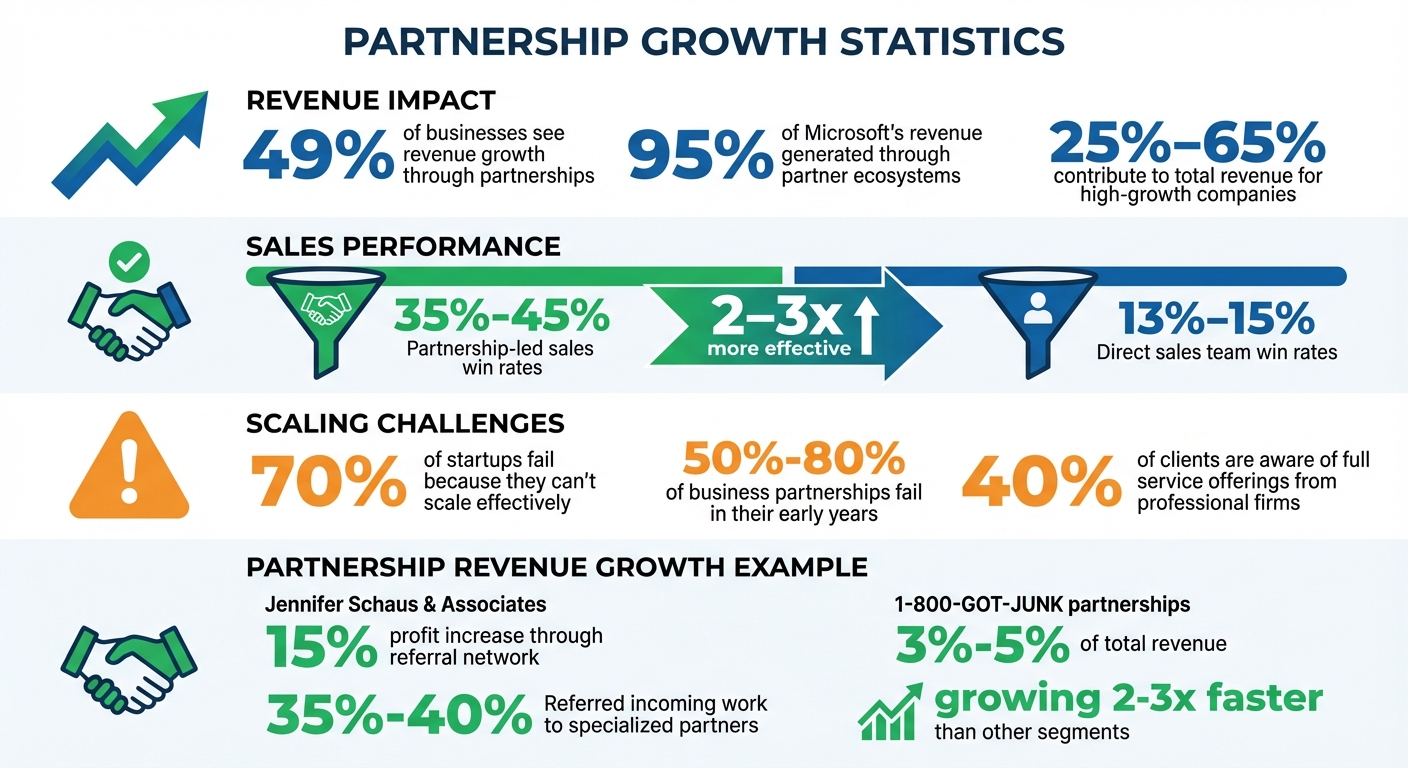
Partnership Growth Statistics for Expert-Led Businesses
Developing Strategic Partnerships That Scale With Less Effort
Why Expert-Led Businesses Struggle to Scale
When it comes to scaling, expert-led businesses face a unique set of challenges. The issue isn’t typically a lack of demand – it’s that growth often becomes tied to the founder. As the person at the center of every client interaction, strategic decision, and quality check, you can quickly become the bottleneck. Kristin Marquet, Founder & Creative Director at Marquet Media, puts it this way:
Scaling isn’t about doing more – it’s about structuring for clarity so that excellence can happen without your constant supervision.
This "founder bottleneck" means that instead of stepping into the role of architect, you remain stuck in the day-to-day operations. The real challenge lies in transitioning from doing the work yourself to teaching others how to operate within the frameworks you’ve built.
The stats back this up: 70% of startups fail because they can’t scale effectively. Relying solely on internal growth creates natural limits, and as teams expand, costs often rise faster than revenue, leading to cash flow problems that can destabilize even successful businesses.
Timing adds another layer of complexity. While operations might scale quickly, building trust and influence takes much longer. Juan Carlos Lascurain-Grosvenor, CEO of Grosvenor Square Consulting Group, highlights the risk:
Influence, credibility, and regulatory confidence take years to build and can be lost overnight if you grow faster than your ability to govern yourself.
Growing too fast can dilute your brand and compromise the quality that earned you your reputation in the first place. This is why timing matters, and why partnerships are often a smarter path to scale.
Strategic partnerships offer a way to overcome the limits of internal scaling. Instead of stretching your team and resources thin, partnerships allow you to tap into established audiences and expertise. Gordon Galzerano, President and CEO of the Strategic Account Management Association, explains:
The companies that were breaking through… weren’t just scaling internally. They were unlocking growth by scaling together through strategic partnerships.
Finding the Right Partners for Your Business
When you’re trying to break free from founder bottlenecks, the key is choosing partners who not only balance out your skill set but also share your vision for growth. A good partnership can either propel your business forward or become a drain on your resources. To ensure success, establish clear criteria before you begin your search.
Start by looking for partners who target the same audience but offer services that complement yours. Think of it like pairing two ingredients that enhance each other without competing. For instance, a business coach could team up with an accountant, creating a seamless experience for clients by addressing different parts of their journey.
Guy Kawasaki puts it perfectly:
Everybody may think that I have the Midas touch, that whatever I touch turns to gold. They’re wrong. I only touch gold.
The reality is sobering: between 50% and 80% of business partnerships fail in their early years. With this in mind, it’s crucial to explore partnership models that align with your goals and business stage.
Common Partnership Models for Experts
Not all partnerships are built the same, and understanding the options can help you pick the one that fits your needs.
- Ecosystem partnerships: These connect you with influencers, industry groups, and thought leaders who can expand your reach. They’re typically informal and develop through networking at events, online communities, or collaborative projects.
- Referral partnerships: A straightforward model where you exchange clients based on trust and proven results. For example, Jennifer Schaus & Associates built a referral network of 16 specialized contractors in 2012, which allowed them to focus on their core expertise in government contracts while increasing profits by 15% from the previous year.
- Brand and content partnerships: This involves co-creating value, such as through joint webinars, courses, or specialized content. It works best when both parties already have established audiences and want to expand their reach.
- Strategic alliances: These go deeper, often involving shared services or technology integrations. A great example is 1-800-GOT-JUNK’s partnership with RE/MAX and Century 21, where they offered discounted services for real estate agents’ clients. This collaboration accounted for 3% to 5% of their total revenue in 2012.
Checking for Alignment and Shared Objectives
After identifying potential partners, it’s time to evaluate them using the SCOPE Framework:
- Scale: Assess their market reach – look at mailing lists, social media following, and domain authority.
- Champion: Identify if there’s someone within their organization who will actively support the partnership.
- Objectives: Ensure your long-term goals and target audience align.
- Proposition: Define the unique value you can create together.
- Executive Stakeholder: Confirm that their leadership is on board with the partnership.
Steve Hellin, a community expert, underscores the importance of alignment:
When objectives are not aligned, there was no reason to prioritize a partnership or put any effort behind co-marketing/co-selling with them.
Beyond the framework, do your homework. Talk to their current or past partners to gauge their reliability and collaboration style. Check their reputation and financial stability through industry connections and social media. Since fewer than 40% of clients are aware of the full range of services offered by professional firms, partners who actively educate their audience can be particularly valuable.
Start small to test the waters. A joint webinar, guest blog, or co-hosted workshop can give you a sense of how well you work together without a major commitment. This low-risk approach allows you to spot potential red flags – like clashing communication styles or conflicting values – before diving into a larger collaboration. Once you’re confident about your shared goals and compatibility, you can focus on building and managing the partnership for mutual success.
sbb-itb-f54b9a0
Building and Managing Partnerships That Work
Once you’ve identified the right partner, the next step is ensuring the partnership operates smoothly. This requires a strong foundation of structure, clear communication, and accountability. Without these elements, even the most promising collaborations can falter, leading to missed opportunities. By focusing on these aspects, you can maximize the potential of your alliances.
Setting Clear Roles and Expectations
To build a successful partnership, it’s essential to establish a shared vision that goes beyond surface-level goals. Aligning on core values, work ethics, and long-term objectives ensures that both parties are working toward the same outcomes. As Gordon Galzerano, President and CEO of the Strategic Account Management Association, puts it:
C-level alignment on shared outcomes – not just deliverables – is what transforms a partnership from transactional to strategic.
Clearly defining roles within the partnership is critical. This includes identifying the primary client contact, assigning decision-making authority, and setting up protocols for resolving disputes. Each organization should also appoint a "deal sponsor" – a senior leader who can champion the partnership, secure resources, and keep teams focused on priorities.
It’s equally important to establish shared KPIs during the negotiation phase. These metrics ensure both parties have a common understanding of what success looks like. For instance, Jennifer Schaus, Principal of Jennifer Schaus & Associates, created an alliance of 16 government contractors in 2012. By pre-negotiating referral fees and defining clear handoff processes, her company referred 35% to 40% of incoming work to specialized partners, resulting in a 15% profit increase between 2011 and 2012.
Communication and Collaboration Methods
Regular communication is the backbone of any successful partnership. Choosing the right methods can help eliminate barriers and provide real-time visibility into operations. Executive sponsorship plays a key role by removing obstacles and ensuring strategic alignment. Meanwhile, alliance management teams monitor progress and flag potential issues early, which is especially important for complex partnerships. Tools like shared tech platforms streamline day-to-day coordination, while quarterly steering committees focus on governance and long-term strategy.
Interestingly, informal connections are just as important as formal meetings. Research shows that successful partners often spend 60% to 70% of their meeting time building trust and strengthening personal relationships, which helps them navigate challenges more effectively.
| Communication Method | Impact | Usage |
|---|---|---|
| Executive Sponsorship | High – clears barriers and provides access | Strategic alignment and resource allocation |
| Alliance Management Teams | High – tracks progress and flags issues | Complex, multi-asset partnerships |
| Shared Tech Platforms | Medium-High – improves coordination | Day-to-day operations and data sharing |
| Regular Steering Committees | Medium – ensures governance adherence | Quarterly strategic reviews |
| Social/Informal Meetings | Medium – builds trust and rapport | Long-term relationship nurturing |
Using a unified dashboard for tracking metrics simplifies communication and reduces misunderstandings. For example, in 2012, 1-800-GOT-JUNK created a dedicated National Accounts and Strategic Alliances department with eight team members to manage partnerships with RE/MAX and Century 21. This structured approach contributed 3% to 5% of the company’s total revenue, with this segment growing two to three times faster than other parts of the business.
Measuring Partnership Performance
Defining roles and maintaining open communication are essential, but measuring performance is what ensures the partnership delivers results. Start by categorizing leads into partner-sourced, co-sell, or influence-driven categories. This clarity prevents internal conflicts and ensures credit is properly assigned.
Key metrics to track include:
- Revenue impact: Partner-led revenue as a percentage of total revenue.
- Sales efficiency: Improvements in win rates and average deal sizes.
- Engagement: Partner participation in training and co-sell activities.
- Operational health: Speed of decision-making and adherence to timelines.
While direct sellers typically have a win rate of 13% to 15%, well-executed partnerships can boost win rates to 35% to 45%.
Annual partnership health checks are another valuable tool. These reviews assess strategy, culture, operations, governance, and financial performance. They can reveal hidden issues and uncover opportunities for improvement before they escalate. Adding a responsibility matrix to clarify timelines and performance metrics further enhances alignment. With a solid structure in place, partnerships can scale effectively and deliver meaningful results.
Using Scale Your Expertise Resources for Partnership Growth
Growing successful partnerships often hinges on creating systems that can scale your expertise without compromising its essence. Scale Your Expertise offers tools and frameworks designed to help you build scalable, high-quality joint offers that maintain the integrity of your unique approach.
At the core of this strategy is the platform’s ExpertOS system, which tackles a common challenge: how to preserve your unique methodology when working with collaborators. As the platform describes it, "ExpertOS is the AI-powered system for turning proven expertise into scalable assets. It captures what makes you brilliant, and turns it into scalable assets – ones that preserve your integrity, multiply your impact, and move your field forward". Essentially, this system transforms what the platform refers to as "invisible IP" – your repeatable decisions, undocumented frameworks, and guiding principles – into structured systems that partners can use reliably. This ensures your methodology remains intact while expanding your market reach.
Another key resource is the Ecosystem Wheel framework, which helps experts identify potential partners across four categories: Ecosystem, PB&J (complementary), Referral, and Brand partnerships. By pinpointing "watering holes" – the online and offline spaces where your ideal clients seek solutions – you can strategically find collaborators who serve the same audience without directly competing. For instance, a business coach might team up with an IP attorney to address complementary client needs. This framework works hand-in-hand with the scalable systems provided by ExpertOS.
The platform also emphasizes efficiency through its orchestration-first model, which leverages AI to automate routine partnership tasks like onboarding, content sharing, and status updates. This reduces manual effort significantly. Additionally, Scale Your Expertise helps experts create enduring assets such as diagnostics, training modules, and co-branded tools. These resources ensure partners have everything they need to operate independently while maintaining high-quality delivery.
This approach encourages a shift in perspective – from thinking like a reactive vendor to adopting a CEO-style mindset. By documenting repeatable decisions and providing partners with clear frameworks, you can ensure consistent delivery. Over time, this method has the potential to make partnerships a major revenue driver, contributing anywhere from 25% to 65% of total revenue.
Conclusion
Scaling an expert-led business doesn’t have to mean hiring more staff or spending a fortune on advertising. Strategic partnerships can drive growth by connecting you with thousands of potential clients through a partner’s established audience, eliminating the need for time-consuming one-on-one outreach. The numbers speak for themselves: partner-influenced deals boast win rates of 35%–45%, compared to just 13%–15% for direct sales. For high-growth companies, partnerships have contributed between 25% and 65% of total revenue within just a few years.
Rather than relying solely on solo efforts, partnerships present a more effective path to growth. However, success requires treating these collaborations as structured alliances rather than casual connections. This involves setting clear governance, shared KPIs, and repeatable systems that partners can follow independently. As Gordon Galzerano, President and CEO of the Strategic Account Management Association, explains:
The next phase of growth won’t be powered by what you control; it’ll be fueled by who you collaborate with.
Scale Your Expertise provides the tools to make this shift, offering frameworks like ecosystem mapping and scalable asset creation. These systems ensure your expertise is preserved and can be delivered consistently by your partners, without demanding constant oversight from you.
Start with one well-aligned partner and focus on delivering value through regular engagement. Over time, these small, intentional steps can lead to major results. With the right strategy and resources, this partnership-first approach transforms your expertise into a sustainable growth engine.
FAQs
What’s the best way for expert-led businesses to choose the right partners for growth?
To select the right partners, start by clearly defining your objectives. Are you aiming to expand your audience, introduce new services, or boost revenue? Pin down your ideal customer profile (ICP) and focus on partners whose audience, values, and offerings complement your own. A shared vision and long-term compatibility are key to building a partnership that fosters mutual success.
After identifying potential partners, assess them based on critical factors like market potential, alignment with your strategy, dependability, ability to scale, and compatibility in terms of values and working style. Consider starting with a small pilot project to test the waters – this can help confirm the partnership’s viability and provide an early glimpse of its potential. The right partnership can extend your reach, let you focus on what you do best, and drive sustainable growth.
What challenges do businesses face when managing partnerships?
Managing business partnerships comes with its fair share of challenges, especially if potential hurdles aren’t tackled early on. One common issue is when partners have misaligned goals. This misstep often creates confusion and leads to a lack of strategic focus. On top of that, communication problems – whether caused by differences in working styles, remote setups, or unclear roles – can chip away at trust and make collaboration difficult.
Another stumbling block is weak governance. Without clearly defined decision-making processes or transparent revenue-sharing agreements, progress can grind to a halt. And partnerships that are rigid or resistant to change often struggle to keep up with shifting market demands or evolving priorities, leaving them vulnerable in the long run.
To sidestep these pitfalls, businesses can set themselves up for success by establishing clear objectives, fostering open and consistent communication, implementing strong governance structures, and staying flexible. With these steps in place, partnerships are far more likely to thrive and deliver meaningful, lasting results.
What are the benefits of strategic partnerships compared to growing a business internally?
Strategic partnerships can unlock growth opportunities that might take years to achieve through internal efforts alone. By teaming up with partners who already have established customer networks, distribution channels, or specialized expertise, businesses can break into new markets and scale more quickly – without the hefty investment of building everything from scratch.
Take this example: working with an experienced distributor can fast-track market entry, cutting down on time and reducing risks compared to assembling an in-house sales team. In fact, research indicates that companies leveraging partnerships can grow twice as fast as those relying solely on their own resources. While internal growth allows for complete control, partnerships often provide a faster and more resource-efficient path for businesses looking to scale with expertise.
Looking for practical tips on building successful partnerships? Check out the resources available on Scale Your Expertise.
Related Blog Posts
- 7 Ways to Scale Your Consulting Business Fast
- 5 Frameworks That Amplify Expert Impact
- Ultimate Guide to Scaling Professional Services
- Top 10 Tools for Scaling Expert Businesses
 Scale Your Expertise