

Your brand story is more than just a tagline – it’s the narrative that defines your professional identity and connects with your audience. To align your story with your expertise:
- Define your strengths: Conduct a self-audit of your skills, achievements, and feedback to identify what sets you apart.
- Focus on your audience: Highlight the problems you solve and the results you deliver, using clear, specific examples.
- Connect values and purpose: Tie your personal principles to your professional goals, creating a story that resonates emotionally and builds trust.
- Structure your story: Use a beginning (your origin), middle (challenges and growth), and end (results and impact) to create a clear, engaging narrative.
- Share consistently: Tailor your message for different platforms while maintaining a unified voice and visual identity.
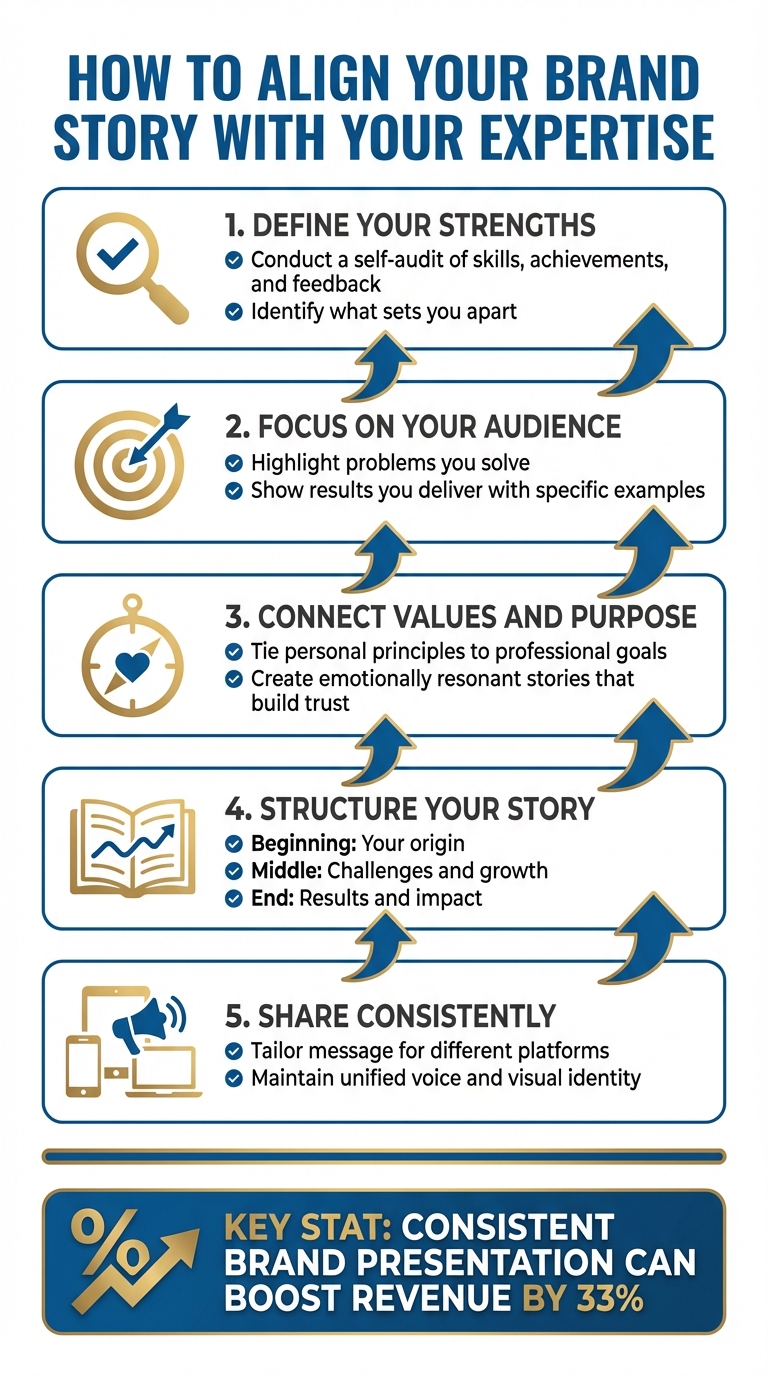
5-Step Framework for Aligning Your Brand Story with Your Expertise
Mastering Storytelling & Brand Alignment with Deirdre Breakenridge
sbb-itb-f54b9a0
Assess Your Expertise and Value
Before diving into your brand story, take a step back to evaluate your career achievements, gather feedback, and identify the strengths that set you apart.
Conduct a Self-Audit
Start by mapping out your professional journey. Create a simple table that highlights your past projects, results, skills, and key takeaways. As you review your accomplishments, look for patterns in the skills you’ve consistently used. Then, take a closer look at your core abilities, passions, and what makes you different. For example, a consultant might note a project where their data analysis led to a 30% revenue increase for a client, showcasing analytical skills as a standout strength.
Sometimes, a self-audit can reveal unexpected insights. One legal professional, for instance, discovered a niche in value-driven client advocacy by analyzing past cases, aligning their personal values of integrity with client needs. Similarly, a branding expert turned what they once saw as failures – seven unsuccessful business models – into a narrative of resilience, which resonated with clients looking for genuine growth advice.
These findings are just the starting point. Use them to build a foundation before seeking feedback from others.
Gather Feedback from Clients and Peers
To validate your self-assessment, reach out to trusted clients and colleagues with specific questions like, "What results did I help you achieve?" or "What stands out about my approach?" Review LinkedIn endorsements and testimonials for recurring themes. If multiple clients mention your knack for simplifying complex strategies, that’s a strength worth noting.
Organize the feedback into categories such as technical expertise, dependability, or communication style. Patterns will emerge. For instance, a coach who analyzed feedback from 50 client sessions might find that empathy stands out as a defining quality, supported by peer reviews mentioning a 90% client retention rate due to personalized guidance. Look for areas where your self-assessed strengths align with what others value most. From there, narrow your focus to two or three key "content pillars" that represent your core strengths.
Compare this external feedback with your self-audit to refine and sharpen your brand focus.
Define Your Value Proposition
Your value proposition should be clear, specific, and rooted in your skills, strengths, and the needs of your audience. It should answer three key questions: Who do you serve? What problems do you solve? What results can you deliver? Avoid vague statements and focus on measurable outcomes. For example, instead of saying, "I’m a business consultant", you could say, "I help consultants cut delivery times in half, backed by results from over 20 case studies".
Consider creating a Signature Framework that connects your expertise to real client challenges. This framework should tie your high-level skills to the tangible outcomes clients care about. By anchoring it to the values and strengths uncovered during your audit, your value proposition will feel authentic and aligned with your personal and professional identity.
Map Your Brand Story to Your Values and Purpose
Once you’ve assessed your skills and defined what sets you apart, the next step is to tie your work to your purpose. This connection transforms your credentials into a story that resonates. When your expertise aligns with your core values, you shift the focus from "what you do" to "why you do it." That "why" builds trust and makes your narrative more compelling. By blending purpose with expertise, you create a story that’s both genuine and impactful.
Identify Your Core Values
Core values are the beliefs that shape how you approach your work. To uncover yours, ask yourself: What drives me? What principles guide my decisions? What unique perspective do I bring to my field?. These values should influence every choice you make and every interaction you have.
Think about the pivotal moments in your career. For instance, if you’ve repeatedly turned down lucrative projects that clashed with your principles, that highlights values like integrity or purpose-driven work. In 2023, a brand designer shared her personal struggles with burnout, entrepreneurship, and parenting on LinkedIn and Instagram. By being open about her challenges and values, she attracted clients who shared her vision – leading to collaborations that aligned seamlessly with her life philosophy. Similarly, another professional used the "TOUR" framework (Transparency, Observation, Understanding, Relaxation) in their LinkedIn posts. This approach helped them secure a major partnership with Nestlé Purina by showcasing authentic results and behind-the-scenes insights.
These values should align with the strengths you identified during your self-assessment. Let them guide how you present your achievements, ensuring every success reflects your principles rather than appearing as isolated milestones.
Connect Your Purpose to Your Expertise
Your purpose defines the impact you want to create, while your values shape how you achieve it. Purpose answers the question, "What difference do I want to make?" Expertise answers, "What skills allow me to make that difference?" When these two elements align, they form a cohesive narrative.
Together, your purpose and expertise become the foundation of your brand. Use real-life examples to illustrate this connection – stories that show how your skills have led to meaningful outcomes. These examples provide proof of your abilities rather than just claims.
Once your purpose is firmly tied to your values, you can craft a message that reflects your journey and the results you’ve achieved.
Write an Authentic Brand Message
Your brand message should weave together your expertise, values, and purpose. A simple structure can help: start with your core belief, share key experiences, and then describe what you currently offer.
Keep your message clear and relatable. Instead of saying, "I’m a business consultant", you might say, "I help B2C and B2B brands tell stories that genuinely connect with their audience". Your message should answer three key questions: Who do you help? What problems do you solve? How do your values influence your approach? Add a conversational touch with a call to action like, "Let’s create something meaningful together".
Authenticity is non-negotiable. Research shows that authentic brands and individuals outperform their competitors by three times. Avoid over-promoting yourself – focus on sharing real challenges and growth moments. This honesty not only makes your expertise relatable but also ensures your brand story leaves a lasting impression.
Build a Story Framework Around Your Expertise
Every strong brand story needs a clear structure. Without it, your expertise might get lost in a sea of disconnected facts. Think of your story as a journey – one that leads your audience from your beginnings to the impact you’re making today. A well-organized framework ties your experiences into a seamless and engaging narrative.
Structure Your Story: Beginning, Middle, and End
Start with your beginning, where you introduce your origin story. This is the moment that sparked your passion or led you to your field. Maybe it was a career shift triggered by a defining event, or years of trial and error that helped you carve out your niche. Stick to the key moment that set you on your path.
In the middle, dive into your journey. Highlight the challenges you faced and the skills you sharpened along the way. For example, if a major setback with a client pushed you to rethink your approach, share that pivotal moment. Use concrete data to back up your growth – something like, "I cut client churn by 30% after refining my feedback process", carries much more weight than a vague claim. This part shows your resilience and how your real-world experiences shaped your expertise.
The end is all about your impact. Wrap up with measurable results and a vision for the future. Instead of saying, "I help clients succeed", get specific: "I’ve worked with over 50 consultants to scale their revenues by 40% using tested frameworks." Connect your achievements to your unique skills and leave your audience with a call to action that positions you as a forward-thinking leader, not someone stuck in the past.
Next, bring your story to life with real-world results through client success stories.
Include Client Success Stories
Client success stories are powerful proof that your expertise works. They shift the focus from what you say you can do to what you’ve actually achieved. Pick two or three examples and follow a simple structure: problem, solution, and result. For instance, "Client X struggled with stagnant growth. Using my framework, their leads increased by 50% in six months."
Take this example: In 2023, a financial advisor helped a small business owner restructure their revenue model. The result? A 35% profit boost in just four months. By transparently documenting the process, including both challenges and breakthroughs, the advisor attracted similar clients seeking reliable guidance. Or consider a leadership coach who worked with a manager struggling with team retention. By introducing a tailored communication strategy, the manager improved team satisfaction scores by 60% in eight months, leading to multiple internal promotions.
Always get permission before sharing client stories, and use direct quotes when possible. These real-world examples validate your expertise far more effectively than self-promotion ever could.
Use Emotional and Relatable Storytelling
While facts and results are essential, emotional storytelling makes your narrative unforgettable. Share the personal stakes behind your journey – the fear you felt during a high-pressure project or the joy of witnessing a client’s breakthrough. Vulnerability doesn’t weaken your professionalism; it makes your story more relatable and human. Aligning your personal stakes with your expertise builds trust and credibility.
Tap into shared challenges your audience might face. For instance: "Like many professionals, I struggled to balance expertise with visibility until I made this shift." Use sensory details and universal themes like perseverance to draw readers in. Keep your stories concise – around 300–500 words – and test them on peers for feedback. Active language and short paragraphs keep the pace engaging while you weave in evidence of your expertise, like case studies or client results. Balancing emotional depth with solid evidence creates a compelling story that resonates and reinforces your authority.
Share Your Brand Story Across Channels
Once you’ve crafted a strong brand story, the real challenge is ensuring it shows up consistently across all the platforms your audience uses. Whether it’s your website, LinkedIn, or email newsletter, your story should feel cohesive and aligned. In fact, research shows that a consistent brand presentation can boost revenue by 33%. While each platform has its unique style, the essence of your story must remain intact. Here’s how to keep your narrative consistent while tailoring it to different channels.
Adapt Your Story for Different Platforms
Your brand voice – essentially your brand’s personality – should stay steady across platforms. However, your tone – the emotional nuance in your communication – needs to shift depending on the context. Think of it like this: you’re the same person whether you’re presenting at a conference or catching up with a friend over coffee, but the way you express yourself changes.
For example:
- Media/PR: Be authoritative and concise, sticking to clear, factual communication.
- Social Media: Go for a playful, casual tone. Use emojis, humor, and GIFs to connect on a more personal level.
- Website/Blog: This is the space for informative, in-depth content. Share insights, personal stories, and your brand’s core values.
- Internal/Email: Keep it warm and conversational. A friendly tone fosters connection and inclusivity.
Here’s a quick reference table to help you fine-tune your approach:
| Platform | Tone | Key Elements |
|---|---|---|
| Media/PR | Authoritative, Expert | Concise, factual, and clear |
| Social Media | Playful, Casual | Emojis, humor, GIFs, and empathy |
| Website/Blog | Informative, Authentic | Detailed insights, personal stories |
| Internal/Email | Warm, Human | Friendly, conversational, inclusive |
Rather than creating entirely new stories for each platform, reuse your core narrative. For instance, if you’ve written a detailed blog post about a client success story, you can repurpose it. Share a key takeaway as a LinkedIn post, turn it into a carousel for Instagram, and reference it in your next email newsletter. The story remains the same, but the format and tone shift to match the platform.
Use Visual Branding and Consistent Messaging
Once your story adapts to different platforms, ensure your visuals and messaging remain cohesive. Your visuals should complement your story, not compete with it. A brand kit with defined color codes, fonts, and logo variations helps ensure every piece of content feels like it’s from the same source. This isn’t just about looking good – brands with consistent imagery and messaging see stronger financial performance.
Branded templates for social media posts, presentations, and media kits can streamline your workflow and maintain a polished, professional look. Ideally, when someone sees your content, they should recognize it as yours before even reading your name. Many top companies create detailed branding guidelines to ensure consistency, even with external collaborators. You don’t need to go overboard, but a simple one-page guide for your team can work wonders.
86% of consumers say authenticity is a key factor in deciding which brands to support. If your messaging feels inconsistent, people will notice – and it could cost you their trust.
Review and Adjust for Consistency
As your brand grows and evolves, it’s crucial to keep your story aligned. Conduct regular audits of your content across all platforms to ensure your language and messaging still reflect your brand’s current direction. This could be an annual review where you check for outdated phrases or themes that no longer resonate.
Focus on engagement quality rather than just vanity metrics like likes. Pay attention to comments like “This really speaks to me” or “I needed this today” – these are signs your story is hitting the mark.
Set up Google Alerts for your brand name to monitor online mentions and address any negative feedback quickly. Why is this important? 61% of consumers will stop buying from a brand they see as misaligned with their values, even if they like the product. Regular reviews allow you to catch any misalignment early, keeping your story sharp and relevant as your brand evolves.
Conclusion
Key Takeaways
Crafting a brand story that aligns with your expertise goes beyond clever phrasing – it’s about forming genuine connections that lead to tangible results. It begins with self-discovery: identifying what makes you stand out, understanding your core values, and pinpointing the unique qualities that separate you from the crowd. From there, draw on pivotal experiences – moments of failure, growth, and client success – that highlight your expertise in action. Stories of transformation hold power: research shows they’re 22% more likely to stick in people’s minds than plain facts. Those "aha" moments and lessons learned? They’re the heart of your narrative.
The structure of your story matters, too. Whether you lean on the Hero’s Journey or a straightforward Character-Conflict-Resolution model, the goal is emotional impact. Position yourself as the guide, empowering your clients to be the heroes of their own stories. Striking the right balance between relatability and capability is key – this builds trust without compromising your professional authority. As Simon Sinek famously said: "People don’t buy what you do; they buy why you do it".
Consistency ties it all together. Your brand voice should be steady across all platforms, even as you adapt your tone for different contexts. A compelling statistic? 67% of Americans – and 80% of older millennials – are willing to spend more on brands whose founders share their values. Regularly reviewing your messaging ensures it evolves alongside your growing expertise.
Armed with these insights, you’re ready to take meaningful steps toward scaling your expertise.
Next Steps for Scaling Your Expertise
Start putting these ideas into action. Write a 4–6 sentence personal brand statement that clearly defines your expertise, the audience you serve, and what makes your approach stand out. This statement should guide all your content creation moving forward.
Adopt the habit of "Homework for Life": spend five minutes each evening reflecting on a moment from your day that encapsulates a meaningful experience. Over time, this practice will give you a library of relatable stories to share. Then, repurpose your core story across different platforms to expand your reach while maintaining a consistent message.
For continued support in refining your brand, building authority, and scaling your impact, check out the resources at Scale Your Expertise. This platform is packed with actionable tools and strategies tailored for experts, coaches, and consultants who want to grow their influence and work with intention. Remember, your story is one of your most powerful assets – make sure it’s working as hard as you are.
FAQs
How can I identify and showcase my unique strengths effectively?
To highlight what sets you apart, start by laying the groundwork for your personal brand. Define your mission, your vision, and the unique benefits you bring to your audience. Identify 3-5 core values that resonate with you and influence your professional choices – these will serve as the pillars of your identity.
Then, take a close look at your online presence to ensure everything aligns. Update your profile photos, bios, and taglines across platforms like LinkedIn, your website, and social media accounts. Your messaging should clearly reflect your expertise and the story you want to share. A unified and consistent narrative makes it easier for others to understand who you are, what you stand for, and the value you bring to the table.
How can I create a brand story that emotionally connects with my audience?
To craft a brand story that truly resonates, focus on being genuine, relatable, and purposeful. Share your values, mission, and expertise in a way that feels natural and reflects your unique perspective. A well-told story builds trust and creates a meaningful emotional connection.
Make your audience the heart of your narrative. Speak to their challenges, goals, or shared experiences. When your story aligns with their needs and demonstrates how you can solve their problems or bring value to their lives, it forms a stronger connection and encourages them to engage with your brand.
At its core, a powerful brand story isn’t just about what you do – it’s about why you do it and how that purpose connects with your audience’s values and priorities. This approach not only strengthens your brand identity but also helps you stand out in a competitive marketplace.
How can I keep my brand story consistent across different platforms?
To maintain a consistent brand story across all platforms, it’s essential to align your messaging, tone, and visuals. Stick to the same language, tone of voice, and visual elements – like logos, color schemes, and high-quality images – wherever your brand appears.
Consistency is key to building trust and making your brand instantly recognizable. Avoid mixed signals, such as using a casual tone on social media while presenting a formal tone on your website. This kind of mismatch can confuse your audience. Make sure your communication aligns with what you actually deliver, creating a clear and reliable brand identity at every touchpoint.
Related Blog Posts
- Framework for Building Expertise-Based Value Propositions
- How to Create a Signature Framework
- Why Positioning Matters for Coaches and Consultants
- Defining Core Expertise: Step-by-Step Guide
 Scale Your Expertise