

Defining your core expertise is how you stand out, charge higher fees, and deliver better results. It’s not about being a generalist – it’s about pinpointing the specific problems you solve better than anyone else. This guide walks you through identifying, refining, and aligning your expertise with market demand to build a stronger, more focused business.
Key Takeaways:
- Why It Matters: Without clear expertise, you risk competing on price alone. Defined expertise helps you command premium fees and simplify your services.
- Steps to Define Expertise:
- Clarify your niche and target audience.
- Evaluate your skills using frameworks like VRIO.
- Identify patterns in your past results.
- Narrow down to 3–6 core strengths that are rare and hard to replicate.
- Align your expertise with market needs and demand.
- Practical Tips:
- Use measurable criteria to define your ideal client.
- Regularly review and refine your expertise to stay relevant.
- Frame your skills as solutions to client problems.
Why This Works:
By focusing on what you do best and matching it with market needs, you avoid being a commodity and create a scalable, high-value business. Let’s dive into the details.
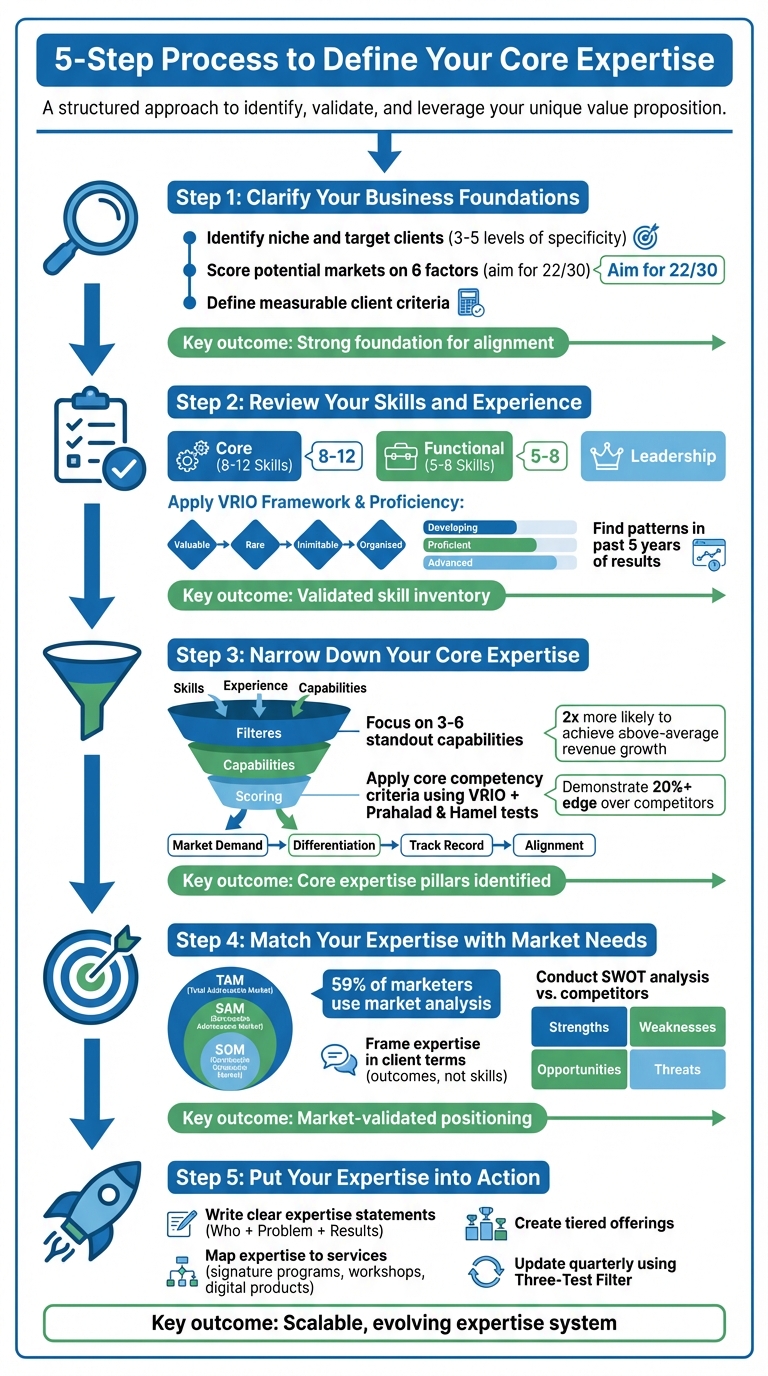
5-Step Process to Define Your Core Business Expertise
The Explainer: Finding Your Company’s Core Competencies
sbb-itb-f54b9a0
Step 1: Clarify Your Business Foundations
Understanding who you serve and the results you deliver is the backbone of your business. This clarity not only shapes your positioning but also impacts your pricing strategy.
Identify Your Niche and Target Clients
Focus on narrowing your niche. Instead of something broad like "office chairs", think along the lines of "feminine, ergonomic office chairs for minimalist spaces" – a more specific and memorable approach. Specializing helps you stand out in the market and justifies premium pricing.
To evaluate potential markets, consider scoring them based on six factors: Experience, Expertise, Results, Potential, Interest, and Access. A combined score of 22 out of 30 indicates a strong, profitable niche.
Aim to refine your niche with 3–5 levels of specificity. For example, instead of stopping at "health", you could drill down further: Health → Diet → Vegan → Athletes → CrossFit. When defining your ideal client, use measurable criteria like company size (revenue or employee count), geographic location, seniority level, and specific roles. The more detailed your client profile, the more effective your marketing becomes.
"The more specific you are about your ideal client, the more specific you can make your marketing, sales, and strategic offers." – Consulting Success
Test market demand by using tools like paid ads, crowdfunding, or referral campaigns. You can also explore platforms like Quora, Facebook Groups, or Google Trends to uncover the questions your audience is asking.
This focused approach creates a strong foundation for aligning your skills with market needs in the next steps. Utilizing frameworks to scale your expertise can further accelerate this alignment.
Define Your Vision and Value
Your vision should outline clear, actionable outcomes – whether it’s saving money, boosting revenue, or improving processes – and always state it in the present tense: "Our company provides…".
To stand out, your expertise must meet three critical criteria: it should be relevant (it influences customer decisions), hard to replicate (not easily copied by competitors), and have a broad application across different markets. Without these, you risk falling into the trap of competing solely on price.
Take stock of your primary skills and score each on a scale of 1–3 in four areas: enjoyment, expertise, market value, and demand. Look for unique combinations that differentiate you. Identify tasks that drain your time but don’t contribute to your strengths – like payroll or admin work – and consider outsourcing them. This frees you up to focus on what truly drives value in your business.
Set aside regular time away from daily operations to work on your strategy. This dedicated time provides clarity and direction, ensuring you stay aligned with your goals as you move forward.
These foundational steps will prepare you to evaluate and refine your core expertise in the next phase.
Step 2: Review Your Skills and Experience
Now that you’ve clarified your business foundation, it’s time to take a closer look at your skills and experience. This step is not about listing every ability you’ve ever had. Instead, it’s about pinpointing the specific skills that deliver real value to your clients and set you apart in the market. The following steps will help you connect your strengths directly to the business foundation you’ve already established.
Group Your Skills into Categories
Start by organizing your skills into three key categories:
- Core competencies: These are organization-wide values like AI literacy or ethical decision-making.
- Functional competencies: These include role-specific technical skills such as coding standards or pipeline management.
- Leadership competencies: These focus on areas like strategic thinking and team development.
Keep your list focused and practical. Aim for 8–12 core competencies and 5–8 functional competencies in each category. Going over 50 total competencies can make the framework too cumbersome to use effectively. To back up your claims, include tangible proof like certifications, case studies, or client success stories. For instance, if you highlight expertise in process optimization, document systems you’ve built and the measurable results you’ve achieved.
As the workplace evolves, consider adding skills in areas like AI interaction, ethical AI use, and asynchronous collaboration to stay ahead of the curve.
Assess Your Skills Using a Framework
To evaluate your skills, apply proven systems and frameworks like the VRIO framework. This method asks four critical questions:
- Is the skill Valuable? Does it help you seize opportunities or mitigate risks?
- Is it Rare? Do few competitors possess it?
- Is it Inimitable? Is it hard or expensive for others to replicate?
- Are you Organized to maximize its value?
Once you’ve identified your skills, rate your proficiency honestly. Use a 3-level model (Developing, Proficient, Advanced) for a quick evaluation or a 5-level model (Novice to Expert) for a more detailed analysis. For example, Cisco adopted a competency-based onboarding approach in 2024, mapping role-specific skills to proficiency levels. This reduced new hire onboarding time from 14 weeks to 9 weeks.
It’s also important to validate your self-assessment with external feedback. Talk to high-performing colleagues or clients to confirm that the skills you consider "core" are actually valued by others. This feedback ensures you aren’t investing in capabilities that don’t align with market needs.
Find Patterns in Your Past Results
Next, look for recurring themes in your achievements. What types of problems do clients consistently bring to you? What challenges have you solved that others couldn’t? These patterns reveal your true expertise and help reinforce the foundation you’ve built.
Pay attention to any "causal ambiguity" in your successes – those hidden strengths that are difficult for competitors to replicate. These are often your most defensible advantages. Additionally, identify the tasks that energize you, as they often align with your functional expertise.
For example, in 2023, a mid-size B2B SaaS company conducted a customer study and discovered that its assumed strength in custom professional services was actually frustrating clients. Customers valued its integration capabilities and product-led growth systems instead. The company shifted resources away from professional services and into product development. Within 18 months, its net revenue retention jumped from 108% to 120%, and gross margins increased by 6–8 percentage points.
Focus on skills you’ve demonstrated successfully and consistently within the past five years. Outdated capabilities, no matter how strong they once were, don’t count as current expertise. Prioritizing recent accomplishments ensures your skills remain relevant and impactful.
Step 3: Narrow Down Your Core Expertise
You’ve identified patterns in your skills and past work – now it’s time to refine your focus. Scaling expertise can be challenging because it’s tempting to hold onto every skill you’ve ever developed. But trying to excel in too many areas weakens your position in the market. Research shows that businesses concentrating on just 3 to 6 standout capabilities are nearly twice as likely to achieve above-average revenue growth compared to those that attempt to be good at everything.
Apply Core Competency Criteria
To narrow your focus, apply the VRIO framework. Each skill should be valuable, rare, inimitable, and organized. Then, use Prahalad and Hamel’s tests to evaluate whether the skill offers broad market appeal, adds significant value for customers, and is difficult for competitors to replicate.
"Core Competences are some of the most important sources of uniqueness: these are the things that a company can do uniquely well, and that no-one else can copy quickly enough to affect competition." – C.K. Prahalad and Gary Hamel
Pay close attention to causal ambiguity – the unique mix of culture, processes, and tacit knowledge that makes your results difficult to reverse-engineer. When competitors can’t figure out how you achieve your outcomes, your expertise becomes more defensible.
Once you’ve applied these filters, you’ll have a clearer picture of which skills truly stand out.
Select Your Key Expertise Areas
Begin by removing skills that are valuable but widely available. If most competitors offer the same capability at a similar level, it’s not a differentiator – it’s a commodity. Instead, focus on areas where you can demonstrate measurable superiority, such as case studies, client testimonials, or performance metrics that show at least a 20% edge over competitors.
Validate your choices with input from clients. Ensure that each expertise area aligns with your strategic vision and addresses the specific problems your target clients need solved. Cross-check your shortlist with the business foundation you established in Step 1. If a skill doesn’t fit your long-term goals, eliminate it – even if you’re highly skilled at it. The remaining skills will form the core pillars of your strategic framework.
Compare Your Expertise Options
With your key areas of expertise identified, evaluate them quantitatively. Create a comparison table to assess each option using four key dimensions: market demand, differentiation, track record, and alignment with your long-term goals.
| Criteria | High Priority Expertise | Low Priority Expertise |
|---|---|---|
| Market Demand | High; clients actively seek and are willing to pay a premium. | Low; perceived as a "nice-to-have" or commodity. |
| Differentiation | Rare; competitors struggle to replicate your results. | Common; competitors offer similar capabilities. |
| Track Record | Proven; backed by measurable case studies and data. | Theoretical; based on potential rather than results. |
| Alignment | High; directly supports 5-year business goals. | Low; unrelated to your long-term vision. |
Use a scoring system (e.g., 1-5 scale) to minimize bias and rank each expertise area. Add up the scores, and the top 3 to 6 areas become your core expertise pillars – the foundation for your positioning and services. Anything outside this list should either be outsourced or deprioritized, allowing you to focus your resources where they’ll have the most impact.
Step 4: Match Your Expertise with Market Needs
Once you’ve nailed down your core expertise, the next step is to ensure there’s a demand for it in the market. This is where you connect your skills to actual revenue opportunities.
Confirm Market Demand
Start by evaluating whether the demand for your expertise outweighs the supply. If clients are actively seeking your skills but there aren’t enough qualified providers, you’ll have more flexibility with pricing and growth. On the flip side, if the market is crowded, you’ll need to stand out in a big way to succeed.
A useful tool here is the TAM/SAM/SOM framework:
- Total Addressable Market (TAM): Everyone who could potentially need your expertise.
- Serviceable Addressable Market (SAM): The portion of that market you can realistically serve, considering factors like location, resources, and delivery methods.
- Serviceable Obtainable Market (SOM): The slice of the market you can realistically capture, factoring in competition and your current capacity.
If your SOM is too small to meet your revenue goals, it might be time to rethink your niche or adjust your positioning.
A 2025 survey of 100 marketers revealed that 59% rely on market analysis to uncover customer pain points. They use tools like Google Search (53%), customer surveys (45%), and competitor websites (38%) to gather insights. To validate demand, you can:
- Conduct surveys using platforms like Google Forms or SurveyMonkey.
- Track industry keywords with social listening tools such as Hootsuite.
- Review negative competitor feedback on sites like Trustpilot.
To ensure your revenue goals are achievable, use this formula:
(Units × Price) – (Cost × Units).
If the numbers don’t work, consider tweaking your pricing, target audience, or service structure.
Once you’ve confirmed market demand, the next step is presenting your expertise through expertise-based value propositions that speak directly to potential clients.
Describe Your Expertise in Client Terms
Clients aren’t buying your skills; they’re buying solutions to their problems. That’s why it’s important to frame your expertise around the outcomes you deliver. For instance, instead of saying, “I offer scheduling software,” you could say, “I help service businesses cut no-shows by 40% with efficient booking systems.”
To get this right, pay close attention to the language your target audience uses when discussing their challenges. Social media listening and review tracking can help you capture these insights.
"The specialist, with their expertise and experience, demonstrates less risk and more promising outcomes than the generalist." – Consulting Success
Next, analyze how your offerings stack up against competitors to pinpoint what makes you stand out.
Compare Yourself to Competitors
A competitive analysis helps you understand where you shine. Start by identifying your direct competitors (those offering similar services to your audience) and indirect competitors (those offering alternative solutions to your target market).
Once you’ve identified your competitors, revisit the unique strengths you outlined earlier. Compare them to what’s already available in the market. Conduct interviews with three or four of your ideal clients, asking them what they looked for in services like yours and why they ultimately chose you. These conversations often reveal your key differentiators.
Using a SWOT analysis can further clarify your position:
| Analysis Component | Description | Purpose |
|---|---|---|
| Table Stakes | Strengths you and your competitors both have. | Necessary for market entry but not a reason clients choose you. |
| Vulnerabilities | Areas where competitors outperform you. | Highlight where you may lose clients. |
| Competitive Advantages | Unique strengths that customers value. | The main reasons clients pick you over others. |
| Market Gaps | Underserved segments or unmet needs. | Opportunities to position your expertise as the solution. |
Keep an eye on negative feedback about competitors through social listening tools. If you spot recurring complaints or unmet needs, position your expertise as the solution to those specific issues. This approach not only sets you apart but also directly addresses real frustrations in the market.
Step 5: Put Your Expertise into Action
Now that you’ve established your market fit in Step 4, it’s time to turn your expertise into practical strategies. With a clear understanding of your strengths and market demand, the next step is to craft messaging that reflects your skills and create services that can scale.
Write Clear Expertise Statements
A strong expertise statement is like your elevator pitch – it tells people who you help, what problem you solve, and what results you deliver. Avoid vague or generic claims. Instead, focus on specifics and highlight proven results.
Here’s a simple template to start: "I use my expertise to help people [specific action or result]". For example, instead of saying, "I’m a software engineer", you might say, "I help healthcare startups build HIPAA-compliant patient portals that cut onboarding time by 50%."
Another effective approach is the "From-To" transformation: "People who pay for my expertise go from [Point A: Pain Point] to [Point B: Desired Result]". This keeps your messaging focused on the real, measurable change you bring to the table.
To make your statement resonate, focus on the problems your audience is actively looking to solve. Spend time researching social media conversations and industry trends to identify gaps and pain points before finalizing your message.
A compelling expertise statement should meet three key criteria:
- Relevance: It directly influences a customer’s decision.
- Difficulty to Copy: It’s unique and hard for competitors to replicate.
- Flexibility: It opens up opportunities across different markets.
"Better is not a brand – it’s a judgment call. Choose traits few others have as opposed to opinions anyone can claim." – Josh Spector
Once you’ve nailed your expertise statement, weave it into your service offerings to create a seamless connection between what you say and what you deliver.
Connect Expertise to Your Services
Your expertise isn’t just something to talk about – it’s the backbone of what you sell. Start by mapping out your processes and methods in an expertise map. This tool helps you identify which elements can be turned into signature programs, workshops, or digital products.
One practical way to scale your expertise is through systematized consulting. Package your knowledge into repeatable processes that deliver predictable results. This could include licensing your methods, offering digital products, or creating frameworks for clients to follow. For example, if you’ve developed a strategy to reduce customer churn, you could offer it as a self-paced course, a group workshop, or one-on-one consulting.
Consider offering tiered services – like Gold, Silver, and Bronze packages – to give clients options while positioning your premium offering as the most comprehensive solution.
To make your services stand out, formalize your insights into a visual methodology. When presenting proposals, review them live with clients. Research shows consultants who do this are twice as likely to win at least 60% of their proposals.
Update Your Expertise Over Time
Expertise isn’t static – markets, technologies, and client needs evolve constantly. What gave you an edge last year might be outdated today.
Set aside time each quarter to review and update your expertise map. Ask yourself:
- What new processes have I developed?
- What skills have I added?
- What topics or methods are no longer relevant?
Many experts use this time to organize their processes into categories like "Sales Funnels" or "Content Systems", uncovering unique methods that can evolve into high-value signature services.
Apply the "Three-Test Filter" regularly to evaluate your expertise:
- Does it still influence customers to choose you?
- Is it still hard for competitors to replicate?
- Does it still open doors to new opportunities?
If the answer to any of these questions is no, it’s time to adapt. Consider the case of Sears: once a retail giant thanks to its mail-order catalog, it failed to evolve when the market shifted to digital retail.
"Some core competencies do expire. Consider Sears’ long-term dominance as the major retailer due to their catalog. Now, that core competency has faded." – Investopedia
To stay ahead, dedicate 50% to 66% of your time on social media to listening rather than posting. Pay attention to what influencers and industry leaders are discussing, and monitor how competitors are adjusting their offerings. As you work with clients, look for recurring patterns and document these insights into frameworks or methodologies. This keeps your expertise scalable and ensures it remains relevant.
Conclusion: Building a Stronger Business with Defined Core Expertise
Defining your core expertise is the cornerstone of creating a business that commands higher pricing and stands out in a crowded marketplace. When you clearly articulate what sets you apart, you avoid falling into the "copycat" trap of competing solely on price. Instead, you become the go-to choice for clients with specific needs, making your business indispensable.
But it’s not just about positioning. Understanding your core strengths brings clarity to how you allocate resources. By focusing on what you do best, you can confidently outsource non-essential tasks like payroll or administrative work. This frees up time and energy to hone the skills and processes that truly make your business unique. A well-defined expertise also sets the stage for scaling professional services. By turning your knowledge into repeatable systems or documented frameworks, you can delegate more effectively, streamline operations, and roll out new offerings more quickly. These steps create a foundation for sustained growth and a stronger presence in your market.
"If we do our job of positioning your firm well, you will be irreplaceable or non exchangeable, and that power translates into a pricing premium." – David C. Baker
This quote underscores how essential it is to define your expertise for maintaining a competitive edge.
However, expertise isn’t something you define once and forget. What gives you an edge today might lose its relevance in just a few years. That’s why regularly refining your expertise is critical. Quarterly reviews, ongoing learning, and applying the Three Tests – Relevance, Difficulty of Imitation, and Breadth of Application – help ensure your expertise stays sharp and competitive. Honda offers a great example: in the 1990s, they leveraged their expertise in engine design to dominate markets ranging from automobiles to motorcycles, lawnmowers, and generators.
Think of your expertise as a living, evolving asset. Businesses that thrive are the ones that continuously refine and sharpen what they do best.
FAQs
How do I find the right niche and audience for my expertise?
Finding the right niche and audience starts with blending your passions, skills, and market opportunities. Think about the topics you genuinely enjoy and where your expertise could translate into something profitable. From there, evaluate potential niches by considering what excites you, what you already know, and where there’s real demand in the market. This prioritization will help you focus on areas with the best potential.
Once you’ve narrowed it down, it’s time to validate your ideas. Dive into research by using tools like keyword analysis, social media trends, or even conducting surveys. Build a detailed profile of your ideal audience, outlining key factors like their age, income, location, values, and the specific challenges they face. This step is crucial for understanding who you’re trying to reach and how your knowledge or offerings can solve their problems.
With your niche and audience defined, put your ideas to the test. Start small – launch a pilot product, service, or piece of content targeted at your audience. Pay close attention to engagement, feedback, and overall results. Use this information to tweak your strategy, and keep refining until you see consistent, positive responses. Tools and frameworks can help you streamline this process, allowing you to grow more efficiently while making a meaningful impact.
What is the VRIO framework, and how can it help identify your core expertise?
The VRIO framework is a strategic tool designed to assess resources and capabilities by addressing four key questions: Does it offer Value? Is it Rare? Is it hard to Imitate? And does your Organization have the structure to use it effectively? If a resource or skill meets all four criteria, it can lead to a long-term competitive advantage.
When honing in on your core expertise, the VRIO framework helps pinpoint the skills or knowledge that truly differentiate you. Start by asking if your expertise solves a critical problem or delivers clear value to your clients. Then, evaluate whether it’s rare – something that few others in your industry can claim. Next, think about how challenging it would be for competitors to replicate. Lastly, ensure you have the systems, tools, or support needed to consistently apply and scale this expertise.
By leveraging the VRIO framework, you can zero in on your most impactful strengths and align them with market needs, ensuring your expertise remains relevant and influential.
How can I make sure my expertise matches what the market needs?
To match your skills with what the market wants, start by digging into your target audience and their needs. Perform a market analysis to uncover gaps, trends, and opportunities. Pay attention to factors like market size, growth prospects, and common challenges your audience faces. Tools such as surveys, social media analytics, and industry reports are great for figuring out what clients value and how much they’re ready to invest – like $150–$300 per hour for executive coaching services.
Once you’ve pinpointed the demand, hone in on your core strengths – the specific skills or knowledge that make you stand out. Align your expertise with market needs by organizing related skills and focusing on areas that address high-priority problems. This approach helps you decide where to concentrate your efforts and phase out less relevant services.
Next, test the waters with a small-scale offering, such as a workshop or a toolkit, and collect feedback. Use this input to fine-tune your services and messaging. Staying on top of market trends and adjusting your strategy regularly ensures your skills remain relevant and valuable.
Related Blog Posts
- 5 Frameworks That Amplify Expert Impact
- Framework for Building Expertise-Based Value Propositions
- How to Create a Signature Framework
- Why Positioning Matters for Coaches and Consultants
 Scale Your Expertise