

Want to stand out as an expert, coach, or consultant? A clear expertise-based value proposition is your key to attracting clients. It focuses on your audience, their biggest problem, and the measurable results you deliver – highlighting your skills and methods. Unlike generic pitches, this approach positions you as a trusted professional who solves specific issues with proven outcomes.
Key Takeaways:
- Target Audience: Define who you help (e.g., SaaS founders, mid-career managers).
- Core Problem: Address their main challenge (e.g., reducing churn, boosting revenue).
- Measurable Results: Promise clear outcomes (e.g., "Increase revenue by 20% in 6 months").
- Your Expertise: Showcase your unique methods, tools, or frameworks.
Why It Matters:
A strong value proposition reduces client uncertainty, attracts better leads, and helps you charge premium rates. It shifts the focus from price to results, making you the obvious choice in a competitive market.
Steps to Create Yours:
- Research Client Needs: Talk to your audience to learn their pain points and goals.
- Define Your Expertise: Highlight what makes you the right fit (e.g., certifications, unique methods).
- Communicate Results: Use data-driven metrics to show the impact of your work.
Pro Tip: Tools like the Value Proposition Canvas or AI platforms (e.g., ChatGPT) can help refine your messaging. Test and adjust your proposition regularly to ensure it resonates with your audience.
Want to craft an effective value proposition? Start with this formula:
"I help [audience] achieve [outcome] using [method]."
Refine it based on feedback, and you’ll have a message that gets results.
Strategyzer’s Value Proposition Canvas Explained
Core Elements of an Effective Value Proposition
An effective value proposition hinges on three interconnected elements: a clearly defined target audience, your unique expertise and differentiators, and the measurable outcomes you deliver. When these work in harmony, they sharpen your focus and amplify your message. Let’s break these down to help you craft a value proposition that resonates and delivers results.
Identifying Your Target Audience
Start by narrowing your focus to the group where your expertise makes the biggest difference. Define key characteristics like industry, company size, decision-maker roles, and their primary challenges or constraints. For instance, a pricing consultant might focus on SaaS founders with $2M–$10M in annual recurring revenue (ARR) who struggle to grow margins without alienating customers.
The secret is to be specific. A clearly defined audience creates instant relevance, allowing potential clients to see themselves in your description. To validate your niche, engage 10–20 potential clients to confirm shared pain points and their willingness to invest in your solution.
Defining Your Expertise
Your expertise should stand out as both relevant and unique to your target market. Aim for a focused niche and a repeatable approach. Strong differentiators could include a proprietary framework, deep knowledge of a specific industry, or tangible proof like certifications and case studies.
By narrowing your focus to a single niche and supporting it with a proven method, you demonstrate credibility and establish trust.
Outlining Client Outcomes
Concentrate on delivering measurable, specific results that align with your clients’ strategic objectives – like boosting revenue, cutting costs, speeding up delivery timelines, or improving customer retention. Use clear, data-driven metrics to connect your outcomes to their goals. For example, you might promise to "increase qualified leads by 30% within 90 days."
Always tie outcomes to your client’s unique context. For a SaaS founder, this might mean improving net revenue retention from 90% to 105% within a year. For an eCommerce brand, it could involve raising the average order value by 20% through pricing and merchandising strategies.
Step-by-Step Framework for Crafting Your Value Proposition
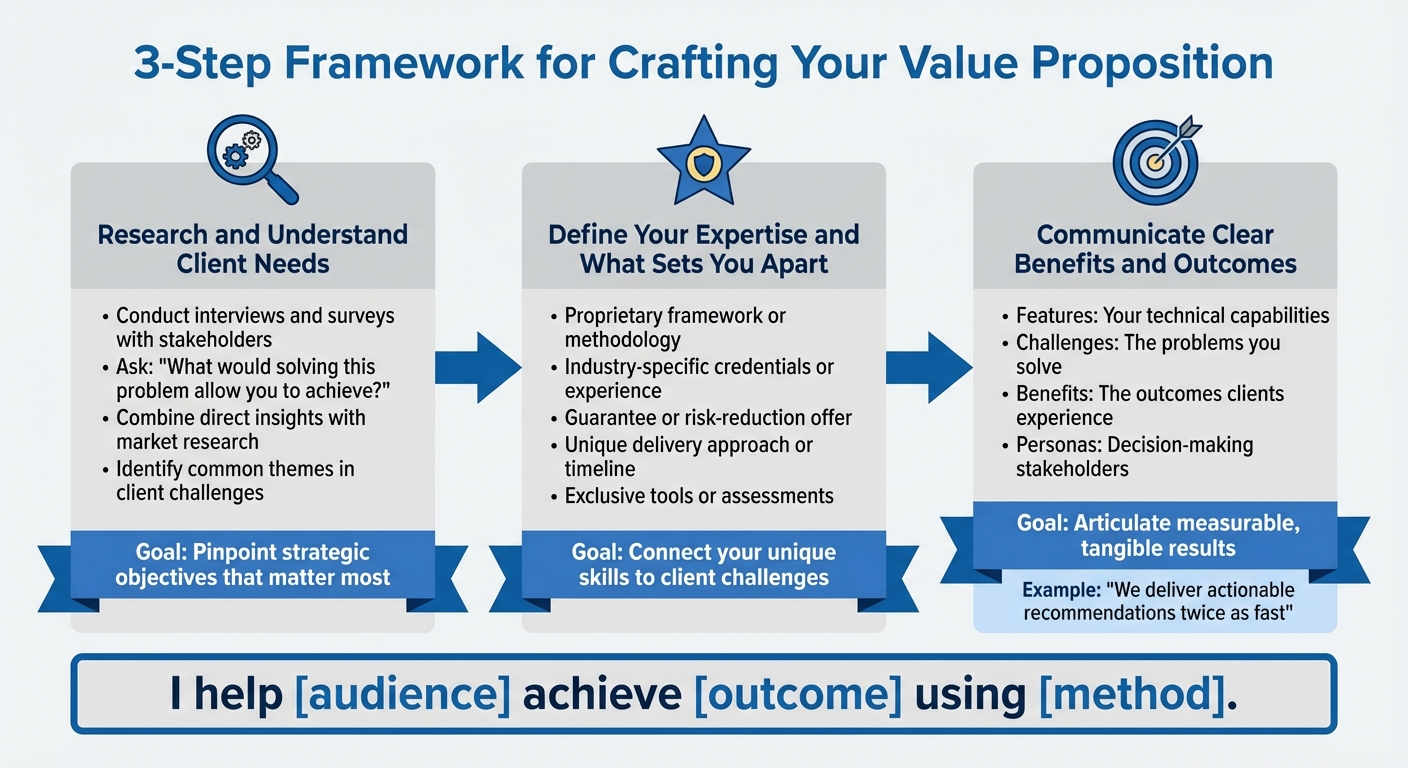
3-Step Framework for Crafting an Expertise-Based Value Proposition
Here’s a simple three-step process to turn your expertise into a value proposition that resonates. This method builds on the foundational elements discussed earlier, guiding you from concept to actionable results.
Step 1: Research and Understand Client Needs
Start by digging into what your clients truly want and need. Conduct interviews and surveys with key stakeholders to uncover their biggest challenges and the outcomes they’re striving for. Ask thoughtful questions like, “What would solving this problem allow you to achieve?” This helps you understand their goals within the broader business context.
Combine these direct insights with market research to identify common themes in client challenges and industry trends. Competitive analysis can also reveal how your clients measure success and what factors influence their decisions. The ultimate goal? To pinpoint the strategic objectives that matter most to them.
Step 2: Define Your Expertise and What Sets You Apart
Once you’ve identified client needs, it’s time to connect the dots to your expertise. Highlight the specific aspects of your skills or services that directly address their challenges. Your differentiators should be both relevant and uniquely yours. These could include:
- A proprietary framework or methodology
- Industry-specific credentials or experience
- A guarantee or risk-reduction offer
- A unique delivery approach or timeline
- Exclusive tools or assessments
For example, if you’re a consultant, you might emphasize how your methodology speeds up strategic recommendations while keeping human insight and expertise at the forefront. Showcase tools, certifications, or methods that demonstrate measurable results. Build credibility by creating proprietary systems or diagnostic tools that clearly communicate your distinct approach.
Step 3: Communicate Clear Benefits and Outcomes
Now that you’ve defined your expertise, focus on articulating the tangible benefits clients can expect. Tie your capabilities directly to their challenges, emphasizing measurable outcomes. Avoid vague promises like “we improve efficiency” and instead aim for concrete results, such as, “we deliver actionable recommendations twice as fast”.
To organize your messaging, consider using a Value Map. This framework brings clarity by breaking your proposition into four key areas:
- Features: Your technical capabilities
- Challenges: The problems you solve
- Benefits: The outcomes your clients experience
- Personas: The stakeholders involved in the decision-making process
This approach ensures your value proposition appeals to both technical buyers focused on features and business leaders who prioritize ROI.
Here’s an example from Software Pricing Partners that illustrates this well:
"Software Pricing Partners helps you develop innovative pricing strategies that delight customers and derange competitors while minimizing risk at every stage of the pricing process."
sbb-itb-f54b9a0
Positioning and Communicating Your Value Proposition
After crafting your value proposition, the next move is figuring out how to position it in a way that resonates with your audience. Tailor your core message to fit the specific needs and priorities of your listeners. Then, think about how to adjust your message across various communication channels to reach different decision-makers effectively.
Crafting Messaging for Different Channels
Different platforms demand different approaches. For websites, keep headlines short and impactful. Proposals allow for more detail, while emails and social posts need to be quick and to the point. In-person conversations? Those need flexibility so you can adjust based on the flow of the discussion. For instance, GrowthHit uses the tagline "Your External Growth Team", which immediately addresses a key pain point for their audience.
It’s also important to focus on what matters most to different stakeholders. Technical buyers want to know the details – how your process works and what features you offer. On the other hand, business decision-makers are more interested in outcomes, like ROI. For example, when talking to a CFO, emphasize cost savings and measurable financial gains. But if you’re speaking with an operations leader, focus on efficiency improvements and ways to reduce risk. No matter the audience, your value proposition should always align with measurable results.
Using Storytelling to Improve Engagement
A generic value proposition won’t stick in anyone’s mind, but a good story? That’s memorable. The best stories highlight the problem your audience faces, show that you understand their challenge, and prove how you deliver real, measurable results.
Take this quote from TIG Brands:
"Once I narrowed that down and got concentrated on the things I did well and the things I enjoyed doing the most, that allowed the scale to happen."
This example shows the power of specialization, turning a concept into something relatable and tangible.
If your offering includes technology or AI, frame these tools as an extension of your expertise, not a replacement. For instance, you could say, "Using advanced analytics and AI-powered tools, we uncover operational inefficiencies that traditional audits often overlook", or "Our AI-enhanced process delivers strategic recommendations in half the time of conventional methods". This approach makes your expertise feel both modern and indispensable.
By blending tailored messaging with compelling stories, you position yourself as the obvious choice.
Examples of Successful Positioning
Here are a few examples of companies that nailed their positioning:
- Software Pricing Partners keeps it simple and focused:
"We don’t try to do everything. We beat all of the name-brand firms because of that singular focus."
- The Point of Loyalty uses a clear and memorable tagline:
"Retain the Best, Grow The Rest."
By addressing customer loyalty across multiple sectors, they manage to appeal to a broad audience while still standing out. - TIG Brands highlights its niche expertise:
"Focused on helping natural product brands grow. We position them to raise capital, prove their growth hypothesis, build community, and scale."
This specific messaging immediately connects with their target market.
Your differentiator doesn’t have to be groundbreaking – it just needs to be something you can own and make relevant. Take Schlitz Beer, for example. Every brewery used the same purification process, but Schlitz was the first to make it part of their message. By claiming a benefit that was already there, they jumped from 5th to 1st place in market share.
The lesson? Consistently emphasize your unique processes, industry expertise, or specialized tools to show how you solve the critical challenges your audience faces.
Tools and Resources for Building Your Value Proposition
Once you’ve outlined your positioning and messaging, the next step is choosing the right tools to shape, test, and refine your value proposition. You don’t need fancy or expensive software – simple frameworks, analytics tools, and resources can help transform your expertise into a clear and compelling offer.
Frameworks and Templates
Start with a framework that connects your expertise to your clients’ needs. One popular option is the Value Proposition Canvas from Strategyzer. This tool divides into two main sections: one side focuses on mapping out your customer’s jobs, pains, and gains, while the other side helps you list your services, pain relievers, and gain creators. It’s a structured way to align your offerings with what your clients value most.
For those working in technical or B2B spaces, the OSP Value Map is particularly helpful. Building on earlier frameworks, it organizes your features (like methods, programs, or intellectual property) into logical groups, ties them to specific client challenges, and highlights the benefits. This creates a unified resource that keeps your marketing, sales, and delivery teams aligned.
Another effective approach is using a 3×3 matrix. This method matches three buyer personas with three core problems, clearly showing how your solutions address each challenge. It’s a great way to lay the groundwork for consistent sales and marketing messaging.
If you’re looking for something simpler, try this straightforward formula to draft your unique value proposition:
"I help [audience] achieve [outcome] using [mechanism]."
Test this in real conversations, refine it based on feedback, and adjust it as needed. These templates work perfectly alongside earlier steps, giving you a practical structure for your messaging.
AI and Analytics Tools
Once your framework is in place, advanced tools can take your value proposition to the next level. AI platforms like ChatGPT, Claude, or Jasper can help analyze interview transcripts, call notes, or survey responses to identify recurring phrases, pain points, and desired outcomes. These insights allow you to prioritize and fine-tune your messaging. AI can also generate multiple versions of your value proposition tailored for different channels – whether it’s a website headline, LinkedIn profile, email subject line, or sales deck.
Analytics tools like Google Analytics, Hotjar, or Mixpanel provide data on how your messaging performs. Metrics like conversion rates, time spent on a page, and scroll depth can reveal whether your value proposition is resonating. For example, if visitors leave quickly or don’t scroll past your headline, it’s a sign your message might need to be clearer. Running A/B tests on different headlines or subheadings can help you determine which version drives more engagement, sign-ups, or proposals. Studies show users decide if a site is relevant within 5 to 10 seconds, so clarity is everything.
Think of your value proposition as a dynamic document. Use performance data to refine it over time. For example, export your analytics, annotate frameworks with proven phrases, and let AI summarize key insights – like “prospects care most about time savings and implementation support, not just cost savings.” Capture these findings in your templates or canvases for future use. Regularly review both qualitative feedback and quantitative data, ideally every quarter, to keep your messaging sharp and effective.
Learning Resources from Scale Your Expertise
To keep improving your value proposition, take advantage of expert-curated resources. Scale Your Expertise is a platform designed for experts, coaches, and consultants aiming to communicate and scale their knowledge more effectively. It offers practical guides, frameworks, and strategies tailored to expertise-driven businesses, making tools like the Value Proposition Canvas easier to fill with clear, differentiated claims.
For example, you can complete a value proposition template for your current offer and then use Scale Your Expertise’s resources to test it against best practices in niche selection, authority building, and AI-assisted workflows. Some standout guides include:
- "5 Frameworks That Amplify Expert Impact"
- "Top 10 Tools for Scaling Expert Businesses"
- "How to Build Online Authority as an Expert (Even If You Hate Self-Promotion)"
These resources provide real-world case studies and actionable strategies to help you refine your messaging and delivery model. They’re designed to turn theoretical ideas into practical execution, ensuring your value proposition truly resonates with your audience.
Key Takeaways and Next Steps
Summary of Core Elements and Framework
Creating a strong expertise-based value proposition boils down to five essential components. First, identify your target audience in detail – know exactly who you’re speaking to. Second, highlight your unique expertise, whether it’s a specific methodology, proven track record, or niche focus that sets you apart. Third, outline measurable outcomes clients can expect, like "reduce churn by 15% in six months." Fourth, back up your claims with evidence, such as case studies or testimonials. Finally, keep your message simple – craft one or two sentences that anyone can grasp instantly. These elements are interconnected: your audience defines what results matter, your expertise shows how you’ll deliver, your differentiators explain why you’re the best choice, and proof combined with clarity builds trust. Together, they form a solid foundation for developing and refining your value proposition.
How to Apply the Framework
Start with three practical steps. First, interview 3–5 past or current clients to uncover specific, measurable outcomes they’ve achieved through your work. Next, list your key differentiators, such as certifications, proprietary methods, or unique approaches. Then, craft three concise value proposition statements using this template: "I help [audience] achieve [result] through [method], so they can [outcome]." Test these statements by using them in visible areas like your LinkedIn headline, email signature, or website hero section. Get feedback from ideal clients or trusted peers to determine which version resonates most. Over the next 30 to 90 days, track simple performance metrics like homepage conversion rates, the number of qualified inbound inquiries, discovery-to-client conversion rates, and average deal size in U.S. dollars. Set up a quarterly review to refine your value proposition based on new client feedback, updated case studies, and performance data.
Where to Learn More
For more guidance, check out Scale Your Expertise, a platform offering actionable resources for experts, coaches, and consultants. They provide tools and strategies to help you position your expertise, integrate AI and analytics, and develop scalable systems that turn your knowledge into results. Visit scale-your-expertise.com to access frameworks, templates, and step-by-step advice that can help you move from planning to execution, ensuring your value proposition resonates with your ideal clients.
FAQs
How do I determine the right audience for my expertise-based value proposition?
To pinpoint your ideal audience, begin by diving into their unique needs, challenges, and goals that align with what you offer. Conduct thorough market research to uncover valuable insights, then develop detailed customer personas to better understand their preferences and struggles. After shaping these personas, test your assumptions by gathering feedback to confirm that your value proposition aligns with what they truly want.
What are some measurable outcomes to highlight in a value proposition?
When putting together a value proposition, focus on showcasing measurable results that highlight the impact of your skills or services. For instance, you might emphasize boosted revenue, better client retention rates, quicker project completions, or higher client satisfaction scores.
You could also point to achievements like gaining new clients, earning industry accolades, or establishing yourself as a leader in your field. These tangible outcomes not only build credibility but also make your value proposition resonate more effectively with your audience.
How can I clearly showcase my expertise to attract potential clients?
To share your expertise effectively, begin by pinpointing the exact problems you address and the tangible benefits you bring to the table. Emphasize the outcomes and changes your clients can look forward to when they choose to work with you.
Develop a clear, value-driven statement that showcases your skills, experience, and the advantages of your services. Use straightforward, relatable language that connects with your audience. Including testimonials, case studies, or success stories can further establish trust and demonstrate your credibility to potential clients.
Related Blog Posts
- Coaching vs Consulting: Which Model Scales Better?
- 5 Frameworks That Amplify Expert Impact
- Top 10 Tools for Scaling Expert Businesses
- Why Positioning Matters for Coaches and Consultants
 Scale Your Expertise